



International supply of industrial raw material
GranulatedSulfur
A technical and commercial briefing on granulated elemental sulfur — what the material actually is, where the world's supply comes from, why it is graded the way it is, what it becomes downstream, and how it moves from a gas processing plant to a buyer's silo without losing mass or grade on the way.
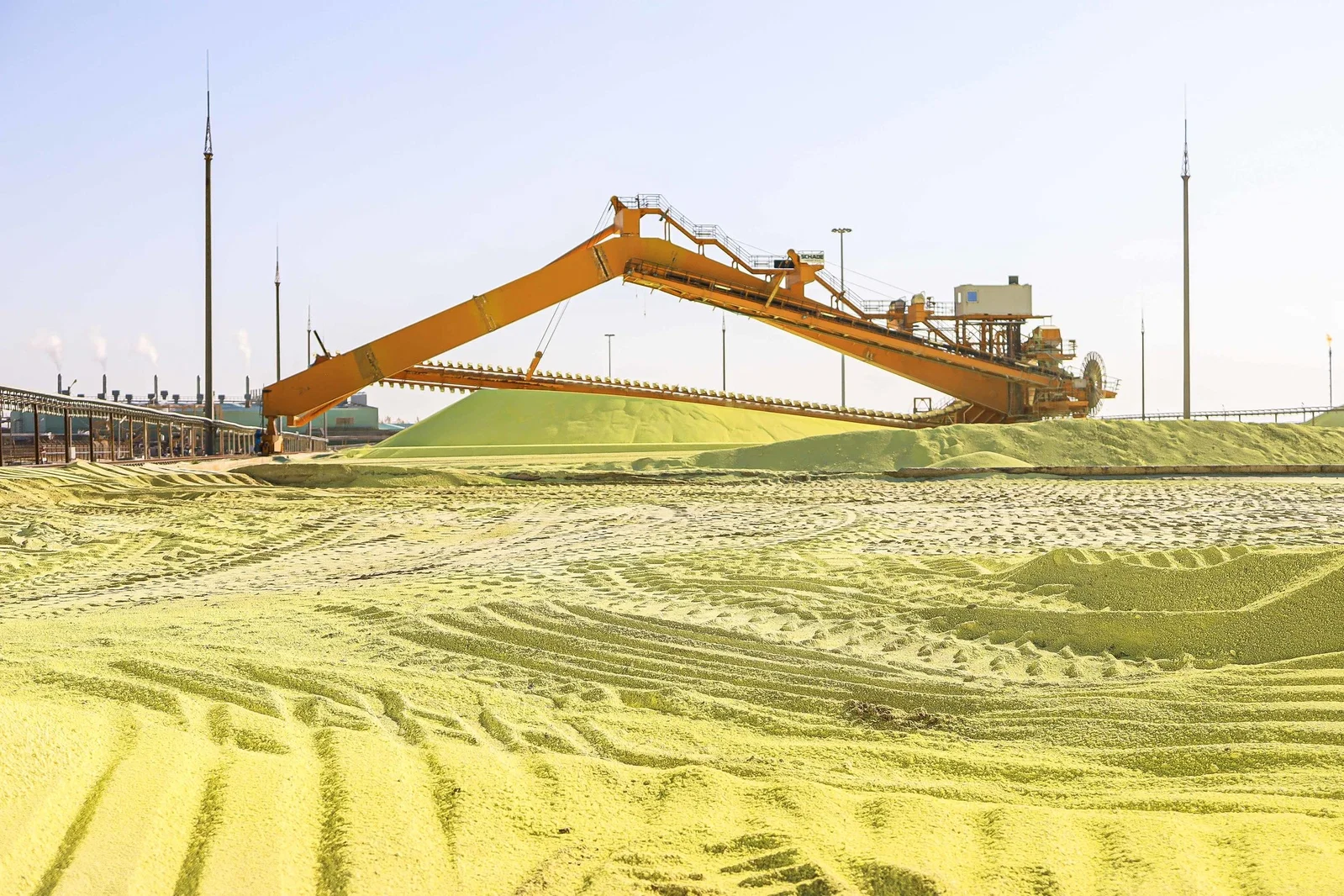
- World output
- ≈71 Mt
- elemental sulfur, 2025 estimate
- Recovered
- > 95%
- as a by-product at oil & gas plants
- Into sulfuric acid
- ≈ 90%
- of all industrial sulfur consumed
- Identified reserves
- > 5 bn t
- worldwide, all forms
What this document sets out
Sulfur is bought on an assay and a screen analysis, not on colour. Everything that follows exists to make those two numbers legible — what each figure means, where it comes from, and what it will do inside a reactor, a granulator or a field.
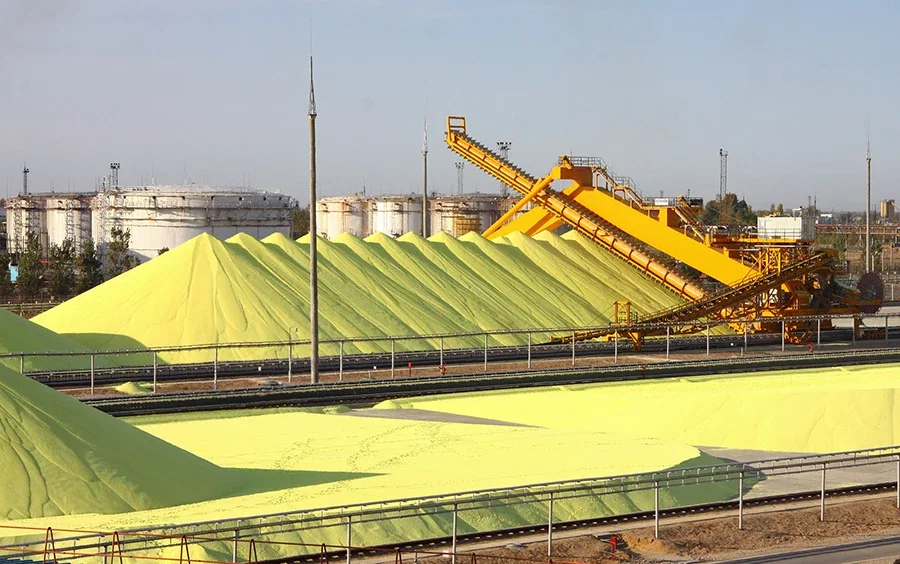
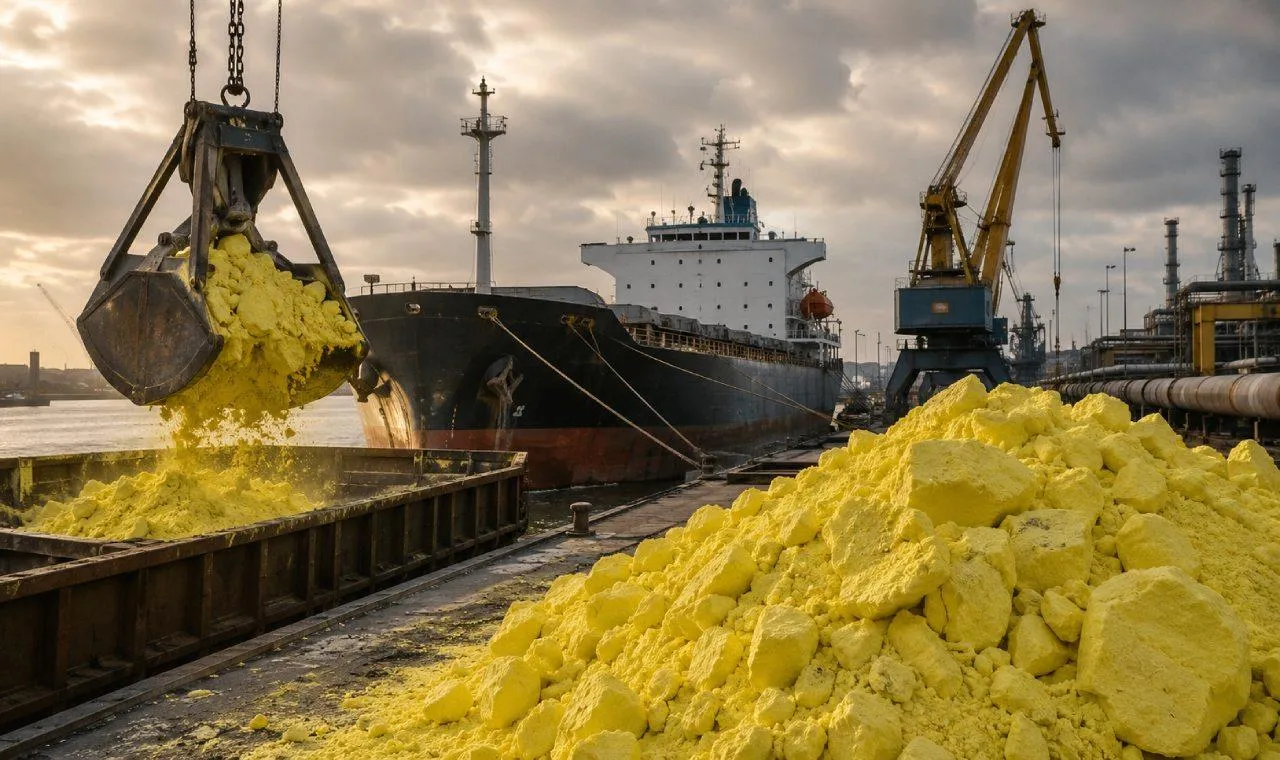
Gaz-Trans International conducts activities aimed at supplying granulated elemental sulfur to international markets in a reliable, consistent manner and in accordance with technical standards, through its partner and trusted intermediary in Türkiye, NİMPRECAST Yapı Elemanları Sanayi Ticaret Ltd. Şti. Independent of any commercial offer or pricing, this document examines in detail the technical elements that define a merchantable sulfur cargo.
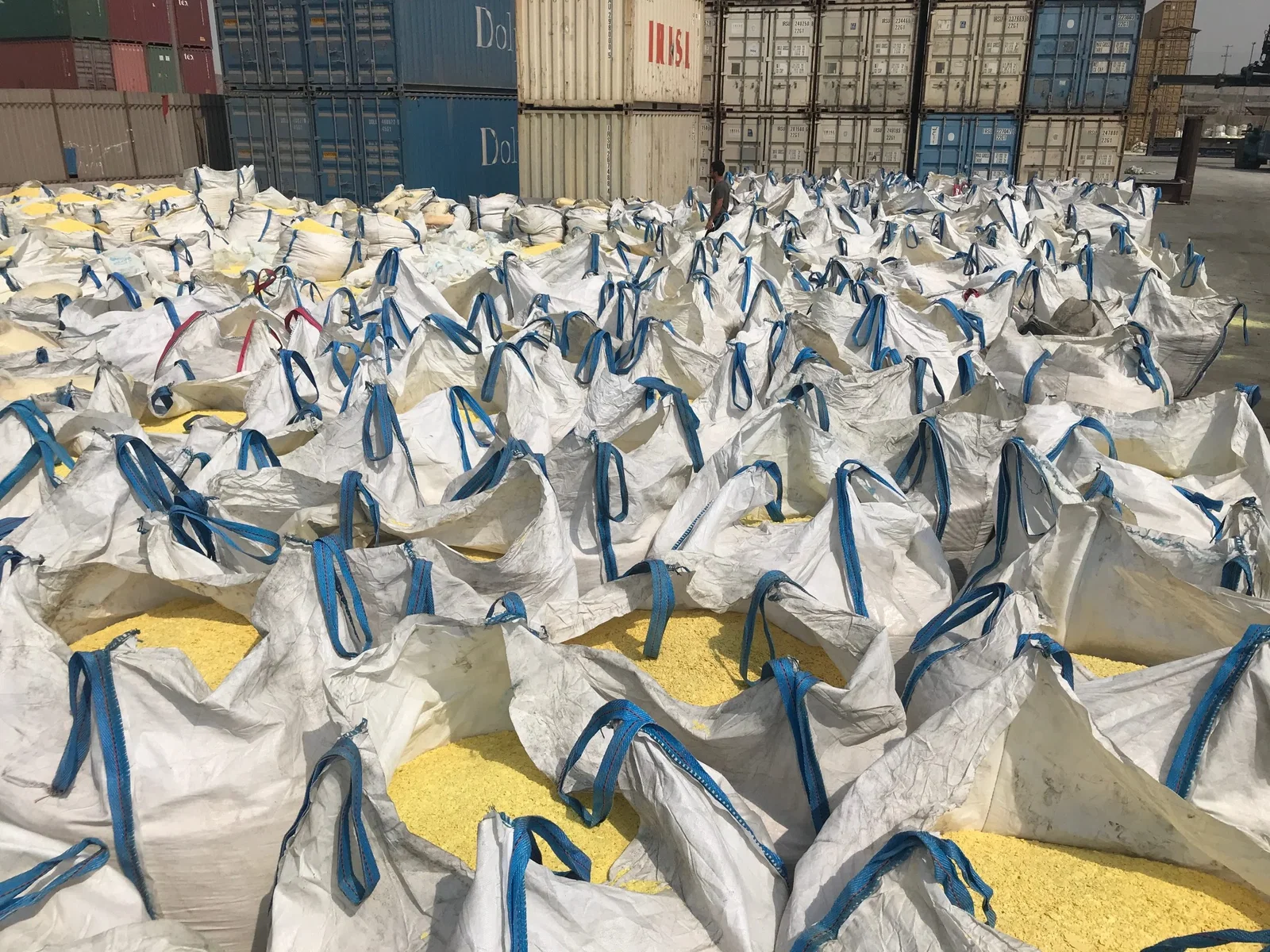
The following pages have deliberately been prepared with a technical focus. Two consignments both described as 99.9 percent sulfur can behave very differently in a sulfuric acid plant, a granulation line or on a field, depending on the recovery route, residual moisture, free acidity, ash and organic carbon, mechanical friability, the proportion of fines below one millimetre, and the conditions under which the cargo was stored and transhipped. For this reason the document focuses not on the headline purity alone, but on the properties that survive the journey. It explains how sulfur is recovered, why the granular form dominates world trade, what the material becomes downstream, and which handling measures keep both the cargo and its surroundings intact.
The first step in this assessment is to define the material itself correctly — because almost every commercial property of a sulfur cargo is a direct consequence of an unusual set of physical constants.
A yellow solid that behaves like nothing else
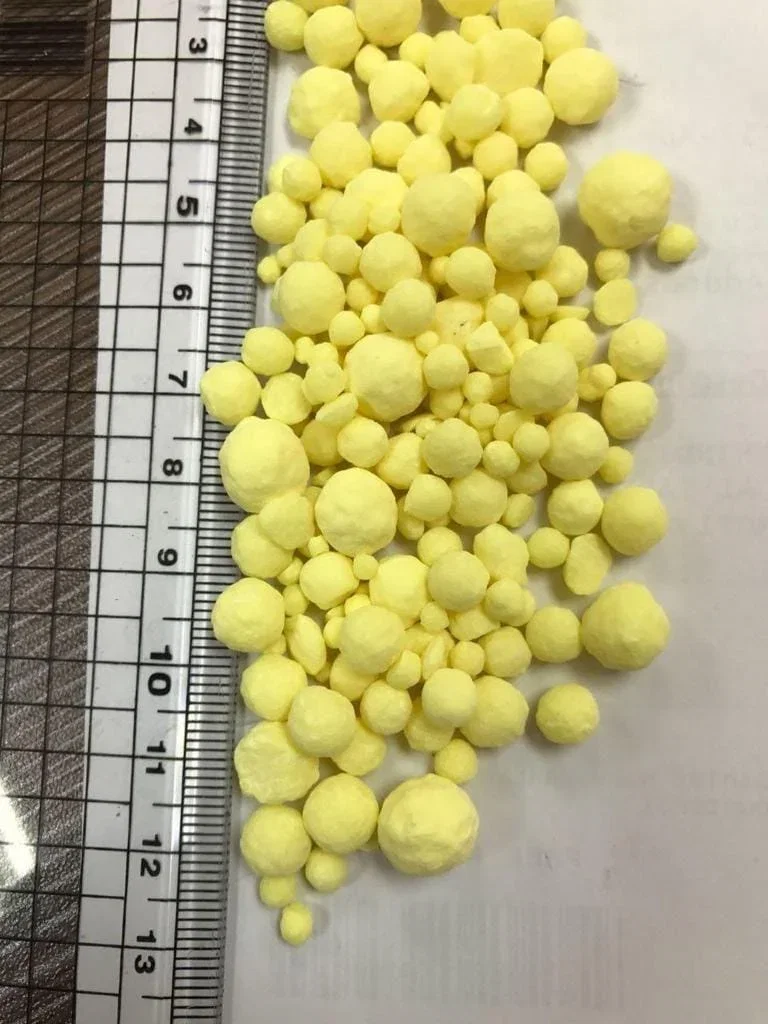
Elemental sulfur is not manufactured. It is separated — pulled out of sour natural gas and crude oil, cooled, and shaped. In its natural state it is a solid crystalline substance that is stable in two modifications: a rhombic form of lemon-yellow colour below roughly 96 °C, and a monoclinic, honey-yellow form above it. Both are built from the same eight-atom ring; only the packing differs.
What makes sulfur commercially unusual is what happens next. It melts at about 120 °C into a thin yellow liquid, and at around 159 °C the S₈ rings begin to open into chains — at which point viscosity climbs by orders of magnitude instead of falling. Heat it further and it polymerises rather than boils. This single curve is why the world trades sulfur in three different physical states, and why the granulated form — solid, dry, free-flowing, shippable without heat — became the dominant merchant grade.
Sulfur is practically insoluble in water and a poor conductor of both heat and electricity. It combines with almost every known element except gold, platinum, nitrogen, crystalline iodine and the inert gases. Above roughly 300 °C, interacting with carbon dioxide in air, it forms the oxides SO₂ and SO₃ — the precursors of sulfurous and sulfuric acid, and the reason that nine kilograms in ten of all industrial sulfur end their life inside an acid plant.
| Property | Value | Remark |
|---|---|---|
| Element | S · Z = 16 | Chalcogen group; the sixth most important nutrient in plant fertilisation. |
| Rhombic form (α) | ρ 2.07 g/cm³ · Tᶠ 112.8 °C | Lemon-yellow. The stable form in every bag, hold and stockpile. |
| Monoclinic form (β) | ρ 1.97 g/cm³ · Tᶠ 119.3 °C | Honey-yellow. Transitional; seen only near hot process lines. |
| Molecular unit | S₈ ring | Common to both crystal forms — only the packing of the rings differs. |
| Melting | ≈ 120 °C | Thin yellow liquid; the state in which sulfur travels in heated tanks. |
| Ring opening | ≈ 159 °C | S₈ rings break into chains; viscosity rises instead of falling. |
| Polymerisation | ≈ 200 °C | Sets to a dark, rubber-like solid rather than boiling off. |
| Solubility in water | Practically nil | The cargo is indifferent to damp air — but dust that reaches water oxidises to acid. |
| Thermal & electrical conductivity | Poor | An insulator. It charges readily by friction, which governs how it must be handled. |
| Chemical reach | Nearly universal | Combines with all elements except gold, platinum, nitrogen, crystalline iodine and the inert gases. |
Two figures decide a sulfur contract. The assay states how much of the mass is sulfur; the screen analysis states how that mass is divided between granules and fines. The first is easy to guarantee at the plant and hard to lose in transit; the second is easy to guarantee at the plant and very easy to lose in transit.
Nobody sets out to make sulfur
More than ninety-five percent of the world's industrial sulfur is not mined. It is removed — stripped out of sour natural gas and crude oil because leaving it in would corrode engines, poison catalysts and breach fuel specifications. The sulfur industry is therefore unique among extractive industries: its output is set by somebody else's decision.
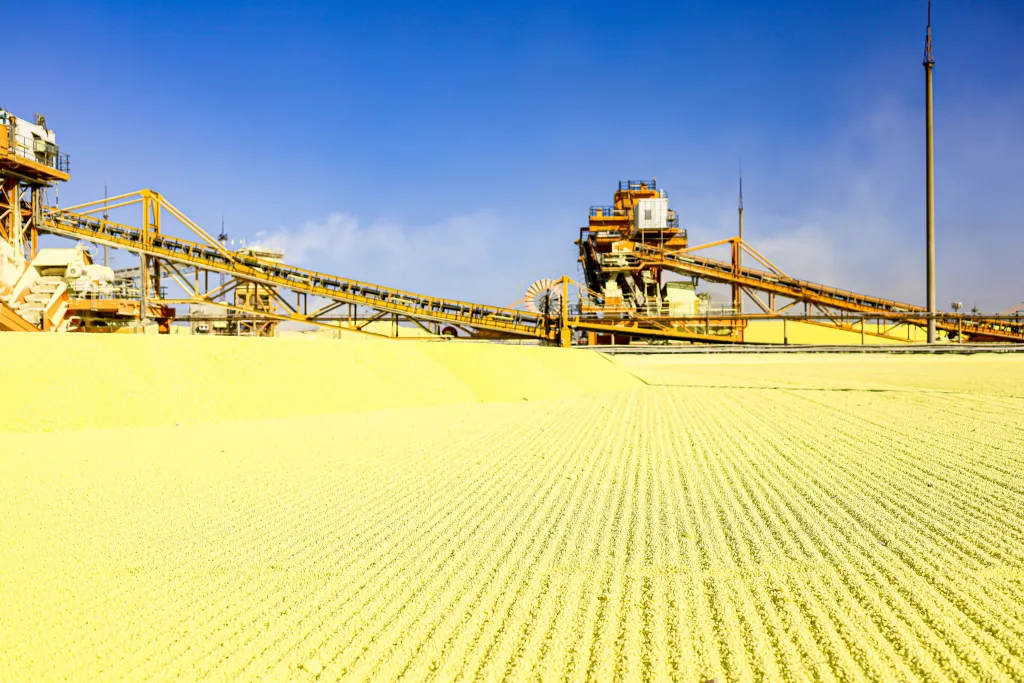
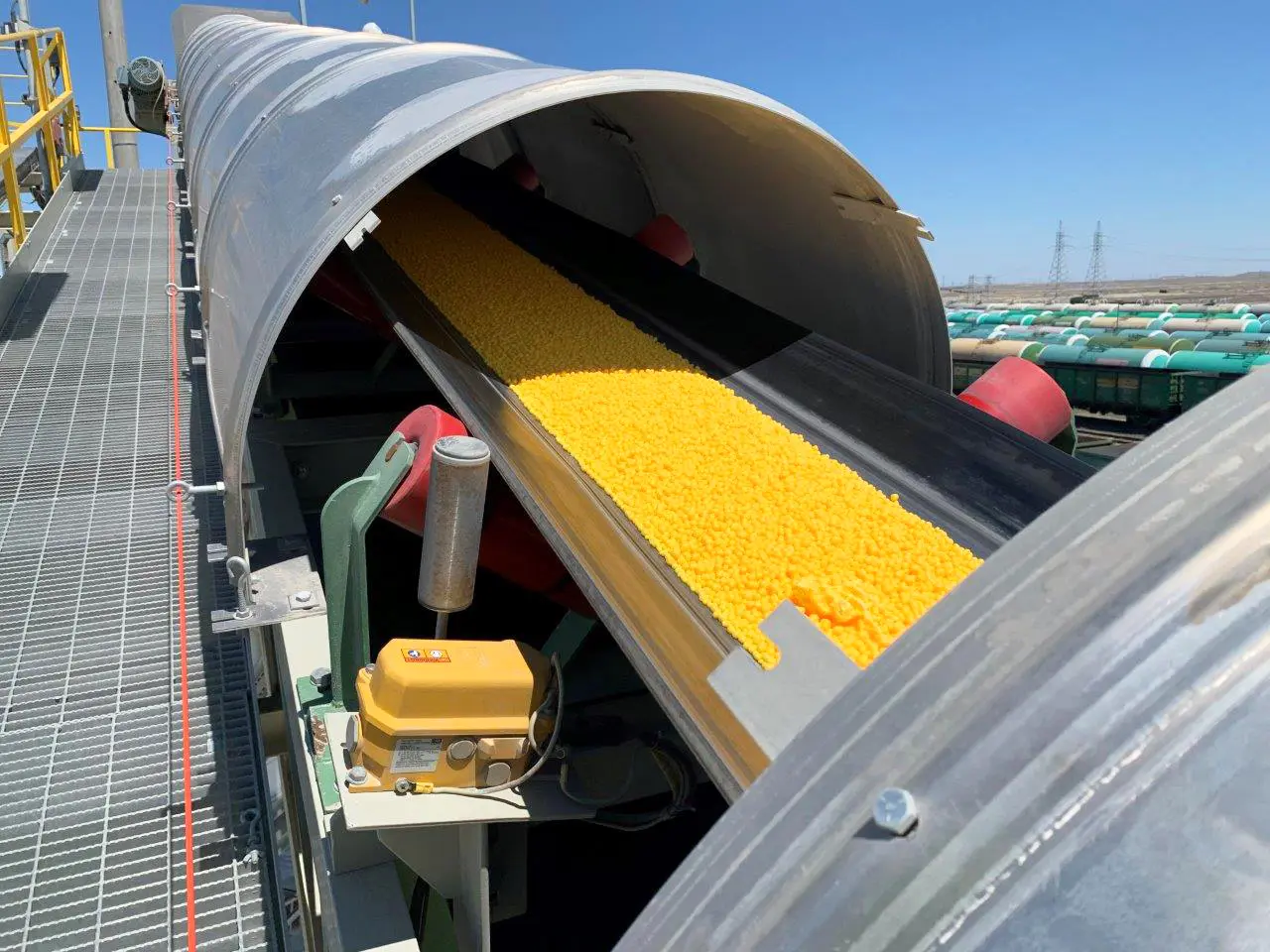

The specialised sector — companies that actually go looking for native sulfur deposits — accounts for only about a tenth of world production. Everything else is a forced by-product. When refiners process more sour crude, or when fuel sulfur limits tighten, more elemental sulfur appears on the market whether or not anyone wanted it. Supply does not respond to price the way a mined commodity does; it responds to refinery throughput and to environmental legislation.
The chemistry that makes this possible is more than a century old. The Claus process, developed in 1883, recovers elemental sulfur from acid gas through a controlled sequence of thermal and catalytic oxidation steps. One third of the hydrogen sulfide is burned to sulfur dioxide; the sulfur dioxide then reacts with the remaining hydrogen sulfide to release elemental sulfur and water. Nothing is added that does not leave again as water.
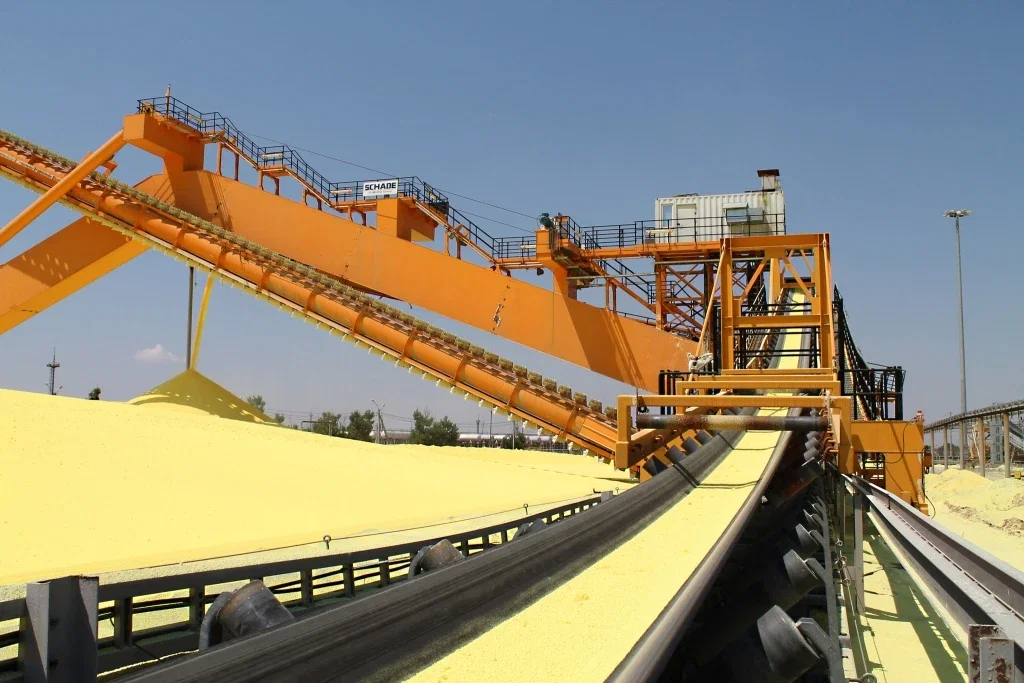
The scale of a single recovery complex explains why the material trades in cargo lots rather than pallets. At the Astrakhan gas condensate field — unique for a sulfur and hydrogen sulfide content reaching twenty-five percent, with acid gas more than half hydrogen sulfide — roughly five million tonnes of sulfur a year accompany twelve billion cubic metres of gas. The granulation complex there alone is rated above two million tonnes a year, feeding two storage warehouses of about one hundred and fifty thousand tonnes each through stackers running at six hundred tonnes an hour.
This is the structural fact behind every sulfur negotiation. A refinery cannot switch its sulfur off, and a storage yard is not an infinite buffer. The producers who consistently reach the export market are the ones who invested in granulation, enclosed handling and dedicated port capacity — because those are the only things that turn an unavoidable by-product into a cargo somebody will pay for.
The map of world supply
World sulfur reserves exceed five billion tonnes, but reserves are almost beside the point. What matters is where sour hydrocarbons are processed, because that is where the sulfur actually appears — and the answer is a short list of countries.
Shares of world volume. The remaining balance is distributed across some forty smaller producing countries.
| Country | Reserve | Character |
|---|---|---|
| Iraq | 335 Mt | The largest identified native sulfur reserve in the world. |
| United States | 200 Mt | Historic Frasch-process province; today overwhelmingly recovered sulfur. |
| Mexico | 100 Mt | Gulf coastal salt-dome deposits. |
| Chile | 100 Mt | Andean volcanic deposits at altitude. |
| Russia · Ukraine · Poland · Turkmenistan | Known deposits | Documented native sulfur, but production is dominated by gas-plant recovery. |
| Japan | Significant | Extracted from volcanic rock — geologically large, commercially marginal. |
For a Turkish buyer the southern corridor is the short one. Cargo leaving a Black Sea or Azov berth reaches Turkish ports in days rather than weeks, which matters for a material whose grade is degraded not by time but by the number of times it is transhipped.
Fourth by volume, built for export
Russia ranks fourth among the largest sulfur producing countries in the world market, at 10.3 percent of world volume. But the rank is the least interesting number here. What matters is what happens to those tonnes once they exist — because the Russian system is organised in a way that sends one specific product, in one specific form, to the export market.
The Russian sulfur market is almost completely monopolised by Gazprom: the company's gas processing enterprises produce approximately eighty-five percent of the product. The remainder is accounted for by Norilsk Nickel and by sulfur recovered in oil refining. According to Rosstat's official data, about six million tonnes of sulfur were produced in Russia, of which some two to three million tonnes are purchased annually by Russian holdings.
For a buyer this distinction is worth more than a rank in a table. It means the granulated tonnage offered to international markets is produced to travel, handled by infrastructure built for export, and not competing at the loading berth with a domestic customer who can simply order it warm through a pipeline. It also means the granulation, storage and port capacity behind it was capitalised on the assumption that the cargo leaves the country.
Only block and granulated sulfur is exported. The domestic Russian market runs on liquid sulfur, taken almost entirely by two fertiliser groups next door to the plants that make it. Granulated sulfur is therefore not a spillover from a saturated home market — it is the designated export product of a system whose internal demand is served by a different physical form altogether.
Gaz-Trans International works inside exactly this structure: granulated product from gas-plant recovery, moved on export-built infrastructure, offered through a partner holding the buy-side mandate in Türkiye. The southern corridor makes the voyage short, and a short voyage is not merely a freight saving — it is one fewer transhipment, one less opportunity for the screen analysis on the certificate to stop describing what is actually in the hold.
Nine kilograms in ten become acid
World consumption runs at roughly sixty-five to eighty-five million tonnes a year, and about ninety percent of it is converted into sulfuric acid — which is in turn consumed overwhelmingly by the phosphate fertiliser industry. Sulfur demand is, to a first approximation, food demand wearing a different name.
Almost all of the sulfur that is obtainable is used to manufacture sulfuric acid, which is itself the key input to phosphate and complex fertilisers.
| Market | Share | Why |
|---|---|---|
| United States | > 25% | The single largest consuming market — phosphate fertiliser production on the Gulf and in Florida. |
| China | > 20 Mt / yr | Largest producer and largest consumer at once. Domestic output cannot meet demand; over 10 Mt is imported every year. |
| Baltic states & CIS | ≈ 9% | Complex fertiliser production and re-export processing. |
| Morocco | ≈ 8% | The world's phosphate rock centre — acid demand tracks phosphate output almost exactly. |
| India | ≈ 7% | Structural import dependence; DAP and NPS production for a growing agricultural base. |
| Tunisia | ≈ 5% | Phosphate processing for export. |
| Brazil | ≈ 5% | Soybean and sugarcane agriculture; one of the fastest-growing fertiliser import markets. |
Two features of this demand profile matter to a supplier. First, it is geographically concentrated — a handful of phosphate provinces set the world price. Second, it is inelastic in the short run: an acid plant cannot pause for a season, so consuming markets tend to secure tonnage on term contracts and treat the spot market as a shock absorber rather than a purchasing channel.
The year sulfur stopped being cheap
For most of the last decade sulfur was the classic surplus by-product — abundant, low-value, and priced accordingly. During 2025 that assumption broke. The global average price more than doubled inside four quarters, driven not by one shock but by three converging demand and supply events.
Türkiye is a structural importer. The repricing arrived here as a value shock rather than a volume one — the country paid substantially more for slightly less material, and began diversifying its origins.
| Indicator | Figure | Reading |
|---|---|---|
| Imports, last twelve months | 343,221 t · US$ 75.4 M | Dec 2024 – Nov 2025. A mid-sized but consistent import market. |
| Import value, Jan–Nov 2025 | US$ 70.93 M · +120% | Value more than doubled against the same period of 2024. |
| Import volume, Jan–Nov 2025 | 288,130 t · −7.98% | Volume contracted while value surged — the classic signature of a price-driven market. |
| Average import price | US$ 102.19 → 219.69 / t | Landed cost per tonne more than doubled year on year. |
| Origin diversification | Italy · Turkmenistan | Both grew sharply as suppliers, challenging the traditional single-origin dependence. |
The practical conclusion for a buyer is not that sulfur has become expensive, but that it has become a contracted commodity rather than an opportunistic one. In a market where volume falls because price rises, the buyers who fare best are those holding term cover, more than one qualified origin, and a corridor short enough that freight and transhipment do not compound the move.
Market figures in this section are drawn from published third-party price series and customs trade data for 2025 and are indicative. They should be re-verified at the date of any commercial offer.
Three ways to sell the same element
Elemental sulfur reaches the market in three physical states — liquid, block and granulated. They are chemically identical and commercially quite different. The choice is not about purity at the plant gate; it is about how much of that purity survives the journey.
| Attribute | Liquid | Block | Granulated |
|---|---|---|---|
| How it is made | Kept molten from the recovery condenser onward | Poured into open bays and left to solidify | Prilled or pastillated from the melt, then cooled |
| How it moves | Heated, insulated tanks — short haul only | Broken out by loader; open grab handling | Free-flowing solid — bulk, big bag or container |
| Free water and H₂S | None while hot, but the tank must never cool | Variable — absorbed during open storage | Negligible |
| Particle size | Not applicable | Random lump; heavy fines generated on crushing | Uniform, typically 2–6 mm |
| Dust on handling | None | Severe — every crush and grab makes more | Moderate and controllable by design |
| Contamination risk | Low, but total if the tank is fouled | High — ground contact, weather, mechanical debris | Low — closed conveyors and sealed transfer points |
| Storage behaviour | Requires continuous heat and energy | Indefinite, but degrades at the surface | Stable; needs dust and fire management |
| Suitability for export | Poor — economics collapse beyond short distance | Moderate — traded, but at a discount | The merchant standard for seaborne trade |
| Typical destination | An acid plant next door to the refinery | Regional consumers, inventory carry | The world market |
The commercial consequence is simple. A buyer who specifies granulated sulfur is not paying a premium for a nicer-looking product; they are paying for the fines they will not have to dispose of, the dust they will not have to suppress, and the tonnage that will still be in the hold when the vessel arrives.
The nutrient nobody notices is missing
Sulfur is one of the six most important nutrients used to fertilise plants, improve soil fertility and increase harvest. It is also the one whose absence is hardest to see — which is why so much of it is applied late, and by accident.
The positive effects of sulfur are frequently overlooked because it acts on the quality of a harvest rather than on its bulk. It raises protein content and gluten percentage in cereals, and lifts the oil content of sunflower, rapeseed and soybean. A field short of sulfur can still produce a respectable tonnage — of grain that mills badly, or of seed that presses poorly.
The external symptoms of sulfur deficiency in plants are almost identical to the symptoms of nitrogen deficiency, because nitrogen and sulfur have similar metabolic roles in the plant. The visible response is therefore to apply more nitrogen — which does not fix the problem, costs money, and leaches. Sulfur deficiency is not usually diagnosed in the field; it is diagnosed in the laboratory, or inferred from the crop that came out of the field last year.
Sulfur-bearing compound fertilisers close that gap directly. In sulfoammofos the nitrogen is present in ammonium form, so it is not washed out of the soil by rainfall and it helps the crop take up phosphate faster and more completely. The sulfur is present as sulfate, which plants absorb without further conversion. Together they partially neutralise alkaline soils and raise the availability of sparingly soluble phosphates already in the ground.
| Parameter | Specification |
|---|---|
| Grade | NP+S = 20 : 20 + 14 — three-component complex (NPS) |
| Total nitrogen (N) | 20% — ammonium form, resistant to leaching |
| Total phosphates (P₂O₅) | 20% — water-soluble, readily available |
| Sulfur (S) | 14% — sulfate form, directly plant-available |
| Chemical basis | Diammonium phosphate (NH₄)₂HPO₄ with ammonium sulfate (NH₄)₂SO₄ |
| Appearance | Solid granules, white to grey |
| Physical character | Non-caking, non-hygroscopic, dust-free, homogeneous particle size distribution |
| Application | Primary and pre-sowing dressing, and as top dressing during vegetation |
| Best suited to | Soils with high available potassium and low available sulfur; all soil types and crops |
| Packing | Polypropylene and polyethylene bags, net 50 kg ± 2% |
| Transport | All modes of transport, in closed vehicles |
| Storage | Closed warehouses |
| Country of origin | Russia |
This is the demand that underwrites the whole trade. A tonne of granulated sulfur leaving a Baltic or Black Sea berth is, three or four transformations later, protein in a loaf and oil in a press — and the specification it was loaded under determines how much of it arrives in a usable state.
Plant, wagon, berth, hold
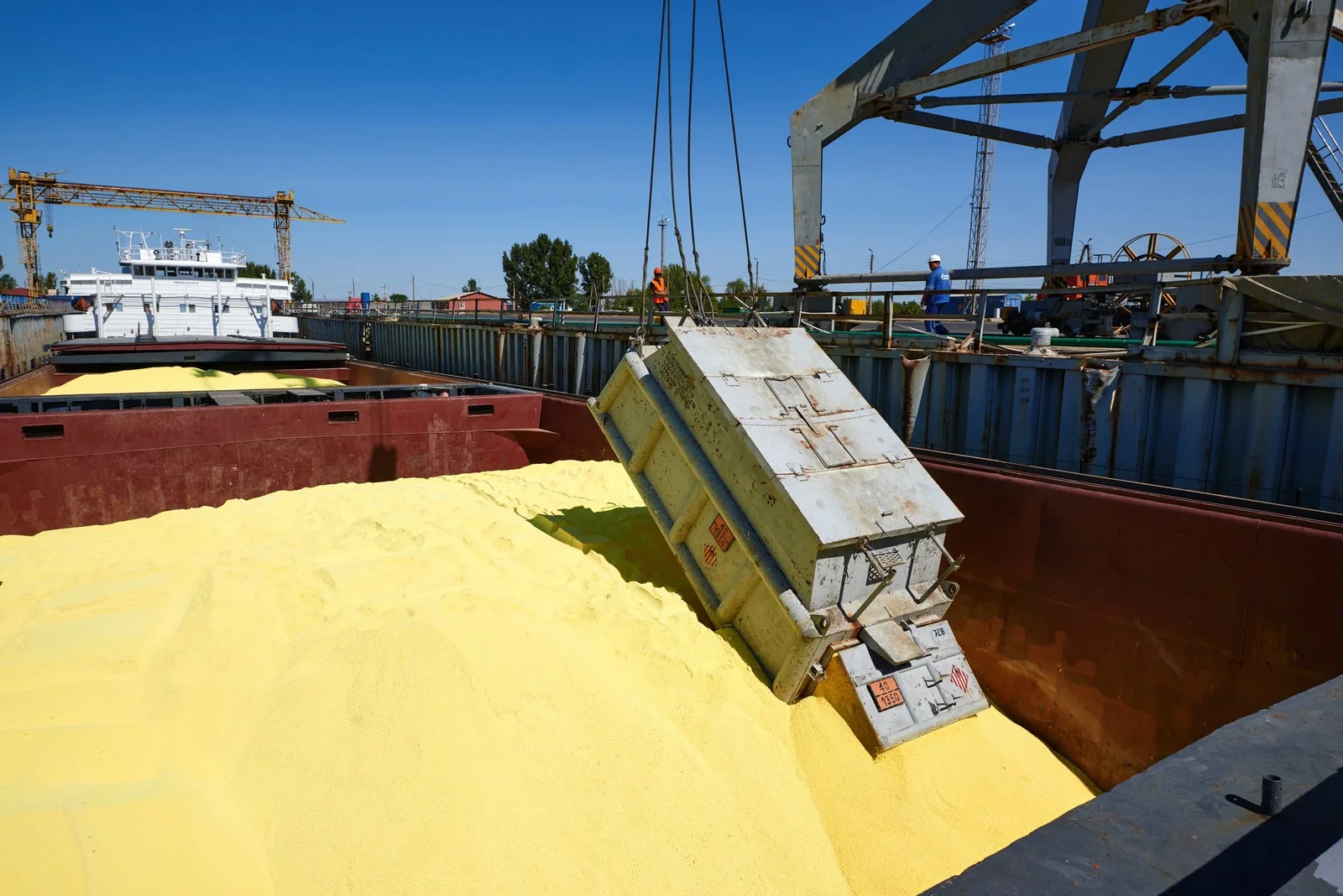
Between the granulator and the buyer's silo a cargo of sulfur is picked up and put down five times. Each transfer is an opportunity to lose mass, gain moisture, generate fines or start a fire — which is why the specification of the handling chain matters as much as the specification of the product.
The process flow at a modern sulfur terminal is designed to exclude any loss of cargo, and it does not fully succeed — some ingress of sulfur into the environment during transportation remains unavoidable. That honest admission is the starting point of the next two sections: what the residual risk actually is, and what is done about it.
What can go wrong, in numbers
Elemental sulfur is not toxic in the way its compounds are. The hazard is almost entirely a hazard of the fine fraction — the dust that every transfer creates, which is explosive, flammable, prone to spontaneous combustion, and which turns into acid as soon as it reaches water. Four numbers define the whole envelope.
| Failure mode | Mechanism | Consequence |
|---|---|---|
| Dust entrainment | Air flows lift the fine fraction at every transfer — stacking, wagon discharge, conveyor junctions, ship loading. | Irretrievable cargo loss, plus deposition of sulfur dust across the port water area and adjacent land. |
| Dust explosion | Sulfur dust mixed with air above the lower explosive limit in an enclosed space. | Fuel–air explosion, with the chain involvement of further masses of a fire-hazardous substance. |
| Friction ignition | Sulfur dust trapped between moving steel surfaces during storage and transport. | Fire, and in documented cases serious accidents where the material was not handled properly. |
| External ignition in wagons | An exposed cargo surface in transit meets a spark source — diesel locomotive exhaust being the classic case. | Wagon fires. Countered by non-combustible or slow-burning surface covers. |
| Electrification | Intense static charging of granules during granulation and reloading; sulfur is an electrical insulator. | Ignition risk. Countered by water irrigation at every transfer point — a measure that cannot be used in freezing weather, which remains an open problem. |
| Water acidification | Deposited sulfur is oxidised in water, both biotically and abiotically, to sulfuric acid and sulfates. | Local depression of pH and elevated metal concentrations; measured local excesses of sulfates, chlorides, iron and magnesium. |
| Soil damage | A sustained sulfur load eventually overwhelms the geochemical barriers that initially restrain it. | Acidification and leaching of aluminium and heavy metals, which can inhibit and kill flora and fauna. |
| Off-grade waste | Accidental releases during equipment operation, plus the mass recovered by mechanical cleaning of premises. | Substandard sulfur requiring hazardous-waste disposal — or conversion into sulfur concrete, the principal outlet developed for it. |
None of this makes sulfur an unusually dangerous cargo. It makes it a cargo with a single dominant failure mode — dust — and a well-understood set of countermeasures. The distinction between a competent supply chain and a careless one is not whether dust is generated, but whether it is suppressed at the point where it forms rather than cleaned up two kilometres downwind.
Every transfer, and what is done about it
This is the operating heart of the dossier: each handling facility, each process step within it, the specific environmental impact that step produces, and the protection measure applied against it. Read as a checklist, it is also the shortest available description of what separates a competent sulfur supply chain from a nominal one.
| Process | Impact on the environment | Protection measure applied |
|---|---|---|
| Oil refinery / gas processing plant | ||
| Granulated sulfur exiting the granulation plant | Emission of dust-forming fractions of granulated sulfur into the air. | Anti-acid treatment of the sulfur granules with a biocide, applied at the granulation unit. |
| Conveyor transport to temporary storage, with intermediate transfer between conveyor sections | Dust emission into the air; pollution of stormwater runoff by sulfur deposited or lost in transit; possibility of fire due to electrification of the material. | Water irrigation of the sulfur during reloading by conveyor transport. |
| Storage by pouring from the conveyor line into stacks in an open area | Wind erosion of the stacks; possibility of fire during long-term storage; possibility of explosion if a large quantity of explosive dust forms. | Irrigation of the stacks and of open loading and unloading points with liquid solutions. |
| Loading onto road and railway transport | Emission of dust-forming fractions into the air during loading. | Treatment of the sulfur with a dust suppressant at the point of loading. |
| Land transport | ||
| Carriage in dump trucks | Emission of dust-forming fractions of granulated sulfur into the air. | Use of specialised containers for road carriage of granulated sulfur, eliminating dust formation in transit. |
| Railway transport | ||
| Carriage in railway wagons | Possibility of ignition from the exposed sulfur surface in the presence of a spark; dust release where covers are damaged. | Special non-combustible or slow-burning covers over the sulfur surface throughout the rail movement. |
| Commercial seaport | ||
| Unloading granulated sulfur from road and railway transport | Dust emission into the air; pollution of stormwater runoff from sulfur deposited or lost during unloading. | Irrigation of the sulfur with water using pulverisers; frequent dust removal and cleaning of the working area. |
| Conveyor transport to the storage warehouse | Emission of dust-forming fractions into the air at every transfer point. | A closed conveyor system; sealing of loading points with protective covers and smooth joining of conveyor belts; aspiration systems drawing off dust-loaded air. |
| Temporary storage of granulated sulfur | Dust emission into the air; possibility of fire during long-term storage; possibility of explosion if a large quantity of dust forms. | A storage facility closed from the environment; frequent dust removal and cleaning of the working area. |
| Scraper reclaimer from warehouse to berth | Dust emission into the air; pollution of stormwater runoff by sulfur deposited or lost during reclaim. | Aspiration systems for the suction of dust-loaded air; frequent dust removal and cleaning. |
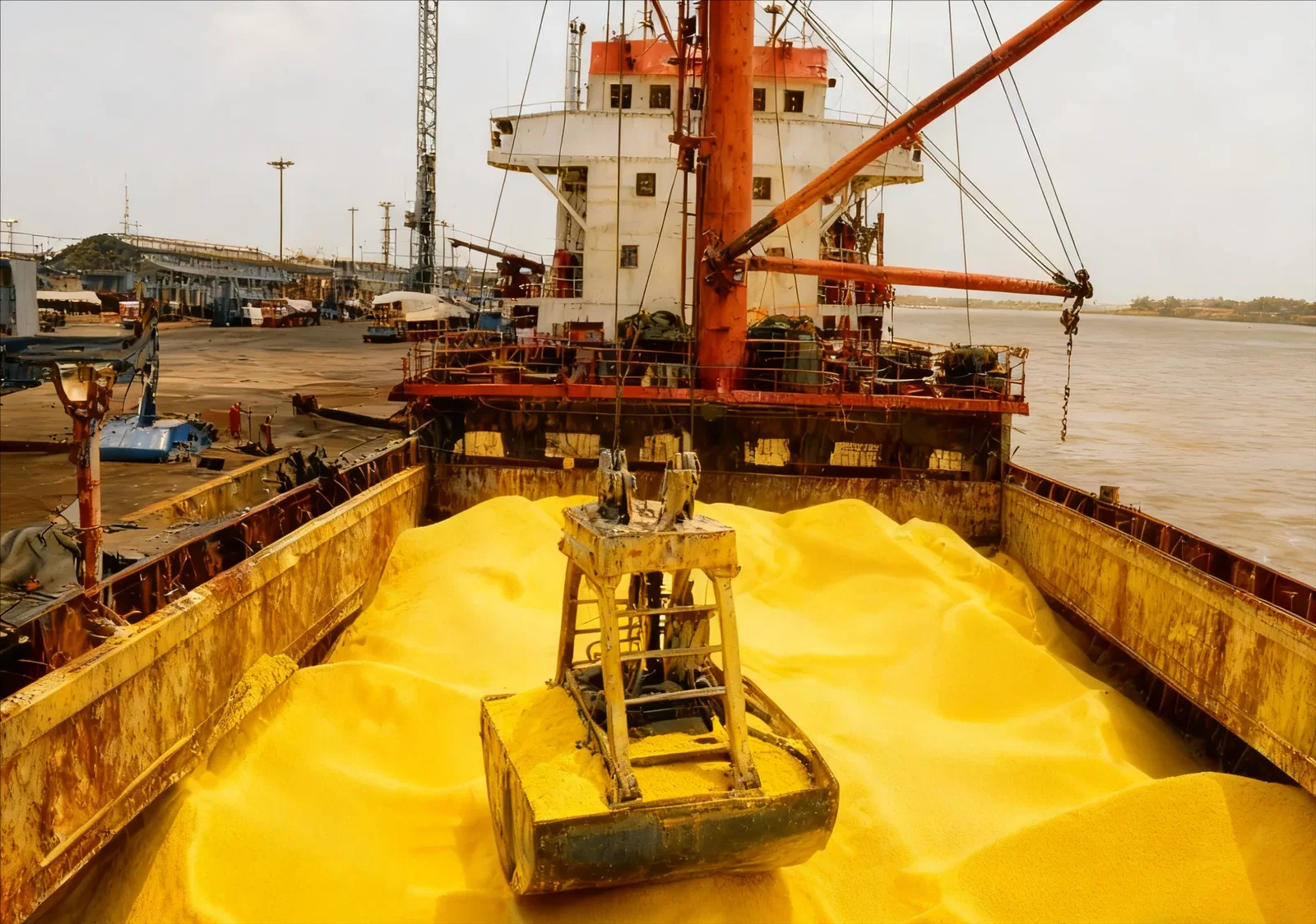
| Shipment by ship-loader into the hold for export | Emission of dust-forming fractions into the air at the point of discharge into the hold. | A dust-suppression aspiration system mounted on the ship-loading machine itself. |
The pattern in the right-hand column is worth stating plainly. Dust is not fought once, at the end; it is fought eleven times, at every point where the material changes hands. Where dust formation still occurs, it is almost always because the measures were insufficient at one stage — and a single unmanaged transfer is enough to put sulfur into water two kilometres away.
Table compiled from the reviewed technical literature on granulated sulfur handling at production, inland transport and seaport facilities.
Two curves decide the next decade
One curve is regulatory and points down: how much sulfur the world is permitted to release into the air. The other is technological and points up: how much sulfur the world can find a use for. The gap between them is the sulfur trade.
A multimodel evaluation using twenty-three atmospheric chemistry transport models set out what global sulfur dioxide emissions would look like in 2030 under three different policy worlds. The spread between them is nearly a factor of six — and it is entirely a matter of what gets captured rather than what gets burned.
| Scenario | Global SO₂ emission | Reading |
|---|---|---|
| Baseline, year 2000 | 55.6 Tg S | The reference against which every projection below is measured. |
| Current legislation, 2030 | 58.8 Tg S | Air-quality law as actually enacted. Global emissions essentially flat for three decades. |
| Maximum feasible reduction, 2030 | 17.9 Tg S | Everything technologically possible, applied everywhere. Sulfate deposition falls by 50–80% across North America, Europe and East Asia. |
| Pessimistic IPCC A2, 2030 | 101.1 Tg S | Almost double the baseline — the world in which desulfurisation does not spread. |
Between a third and a half of all sulfate deposition currently falls on the ocean rather than on land. The practical implication for this industry is worth stating without modesty: every tonne of elemental sulfur recovered at a Claus unit and sold as a commodity is a tonne that did not leave the stack as sulfur dioxide. Sulfur recovery is an emissions-control technology that happens to produce a saleable product.
More than sixty million tonnes of sulfur are produced every year, and the surplus has been a standing problem for decades. The response has been a sustained search for uses beyond acid — and the most interesting of them treat sulfur not as a reagent to be consumed, but as a structural material in its own right.
| Characteristic | Li-ion cells | Li–S cells |
|---|---|---|
| Cell voltage | 3.4–4.0 V | 2.15 V |
| Cathode specific capacity | 140–200 mAh g⁻¹ | 1,675 mAh g⁻¹ |
| Theoretical specific energy | 500–600 Wh kg⁻¹ | 2,600 Wh kg⁻¹ |
| Practical specific energy | 150–200 Wh kg⁻¹ | 200–700 Wh kg⁻¹ |
| Theoretical energy density | 1,800 Wh L⁻¹ | 2,800 Wh L⁻¹ |
| Cycle life | 300–1,000 deep cycles | < 200 cycles |
Read together, the two curves explain why 2025 repriced this market and why the repricing is unlikely to fully reverse. Regulation keeps pulling sulfur out of fuels, which sets supply. Technology keeps finding new places to put it — phosphate for batteries, acid for nickel, sulfate for soil — which sets demand. A material that was treated as a disposal problem for most of a century is being re-read, correctly, as a strategic input.
Next step
From specification to cargo
This dossier is deliberately free of prices and volumes. It exists so that a commercial conversation can start from the same technical vocabulary on both sides of the table — the same assay, the same screen analysis, the same understanding of what a closed handling chain is worth.
This document is technical in nature and does not constitute a commercial offer. Figures drawn from published literature and third-party market data are indicative and should be verified against the governing contract and current certificates of analysis.