
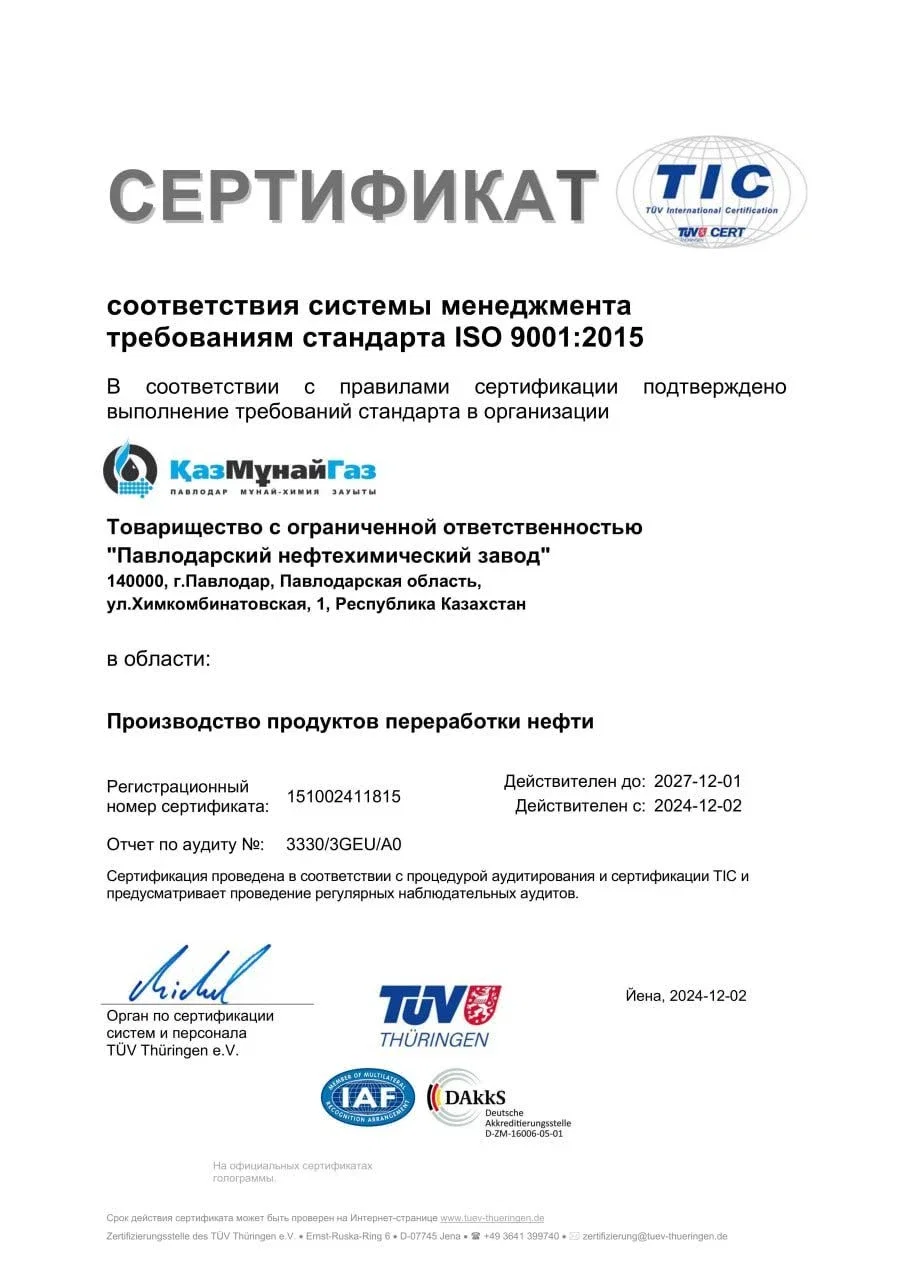
ISO 9001:2015
Quality Management System
- Certifying body
- TIC · TÜV Thüringen e.V.
- Registration no.
- 151002411815

 In cooperation with
Industrial sulfur supply of Kazakh origin
A complete supply dossier for granulated technical sulfur originating from the Pavlodar Petrochemical Plant: the quality profile of the product verified by laboratory test results, the producer's accredited management system certificates, a volume-based calculation of the rail and ferry logistics running along the Middle Corridor to Batumi, the wagon fleet requirement, the cost structure and the delivery terms.
The letter of intent dated 21 May 2026 concerns the supply of granulated technical sulfur of Kazakh origin, in a range of 25,000 to 50,000 tonnes per month, delivered at the port of Batumi (Georgia). This dossier sets out the technical and commercial answer to that request.
At these volumes this is no longer a matter of “a few wagons”. Fifty thousand tonnes a month means fully fledged industrial rail logistics at commodity-export scale: near-daily dispatch, a continuous loading window at the station, coordination with KTZ, stable fleet management and uninterrupted work with the port. Four to five separate operators are involved in the chain.
Against this, Kazakh origin carries one decisive advantage: a clean sanctions profile. No Russian port, no Russian bill of lading, no re-export ambiguity, documents are transparent. For many banks and Asian buyers this is a criterion that outranks price negotiation. Where a buyer stipulates “non-sanctioned origin”, Kazakh sulfur is a very strong advantage.
Preliminary conclusion: the plan is technically feasible. It is, however, a serious commodity logistics operation with a high dependency on the Caspian Sea and a requirement for very good coordination. To run reliably it needs a strong TITR forwarder, guaranteed wagon access, Caspian ferry slots, wagon turnaround control, port access in Batumi and a highly efficient coordination chain.
The product covered by this offer is technical gas sulfur as defined under GOST 127.1-93, grade 9998. The four digits in its name correspond to the minimum sulfur mass fraction required by the standard: 99.98%. That is a floor, not a target.
The product is supplied in granulated form. Granulation reduces dusting and the ignition risk arising from static charge, and it makes bulk handling and long-distance rail transport possible. Bulk density is in the range of 1.05–1.25 t/m³, which is why the loading limit of a wagon is set by weight rather than by volume.
| Item | Value |
|---|---|
| Product name | Technical gas sulphur |
| Grade | 9998 |
| Standard | GOST 127.1-93 — “Technical sulfur. Specifications” |
| Physical form | Granulated |
| Bulk density | ≈ 1.05–1.25 t/m³ |
| Test method | GOST 127.2-93 |
| Sampling | GOST 127.3-93 |
| Production unit | KÜPS — sulfur granulation section |
| Producer | LLP “PNHZ” / LLP “POCR” — Pavlodar Petrochemical Plant |
| Certificate of conformity | KZ.7500610.01.01.56577 · valid until 25.12.2026 |
| Delivery format | Bulk; big bags on request |
The figure in the grade designation and the figure in the quality passport are not the same thing. The standard requires 99.98%; the value actually measured on the lot to be shipped is 99.99%. The next section sets out all of the test results for that lot alongside the normative limits.
The values below are taken from quality passport no. 349.01. The left column shows the limit required by the standard, the right column the value actually measured in the laboratory for the lot concerned. For all six parameters the measured value stays on the safe side of the normative limit.
| # | Parameter | Test method | Norm | Measured | Margin |
|---|---|---|---|---|---|
| 01 | Sulfur mass fraction, %, min. | GOST 127.2-93 cl. 2 | 99.98 | 99.99 | above the norm |
| 02 | Ash mass fraction, %, max. | GOST 127.2-93 cl. 3 | 0.02 | 0.005 | 4× below limit |
| 03 | Organic matter mass fraction, %, max. | GOST 127.2-93 cl. 5.3 | 0.01 | 0.005 | 2× below limit |
| 04 | Acids expressed as sulfuric acid, mass fraction, %, max. | GOST 127.2-93 cl. 4 | 0.0015 | 0.0002 | 7.5× below limit |
| 05 | Water mass fraction, %, max. | GOST 127.2-93 cl. 12 | 0.2 | 0.007 | 28× below limit |
| 06 | Mechanical impurities (paper, wood, sand, etc.) | GOST 127.1-93 cl. 4.3 | not permitted | none | clean |
The technical gas sulfur conforms to the requirements of GOST 127.1-93 “Technical sulfur. Specifications”. Information on the filling of the product into reservoirs and tank wagons, the product name, the lot number and the date of production is declared by the producer.
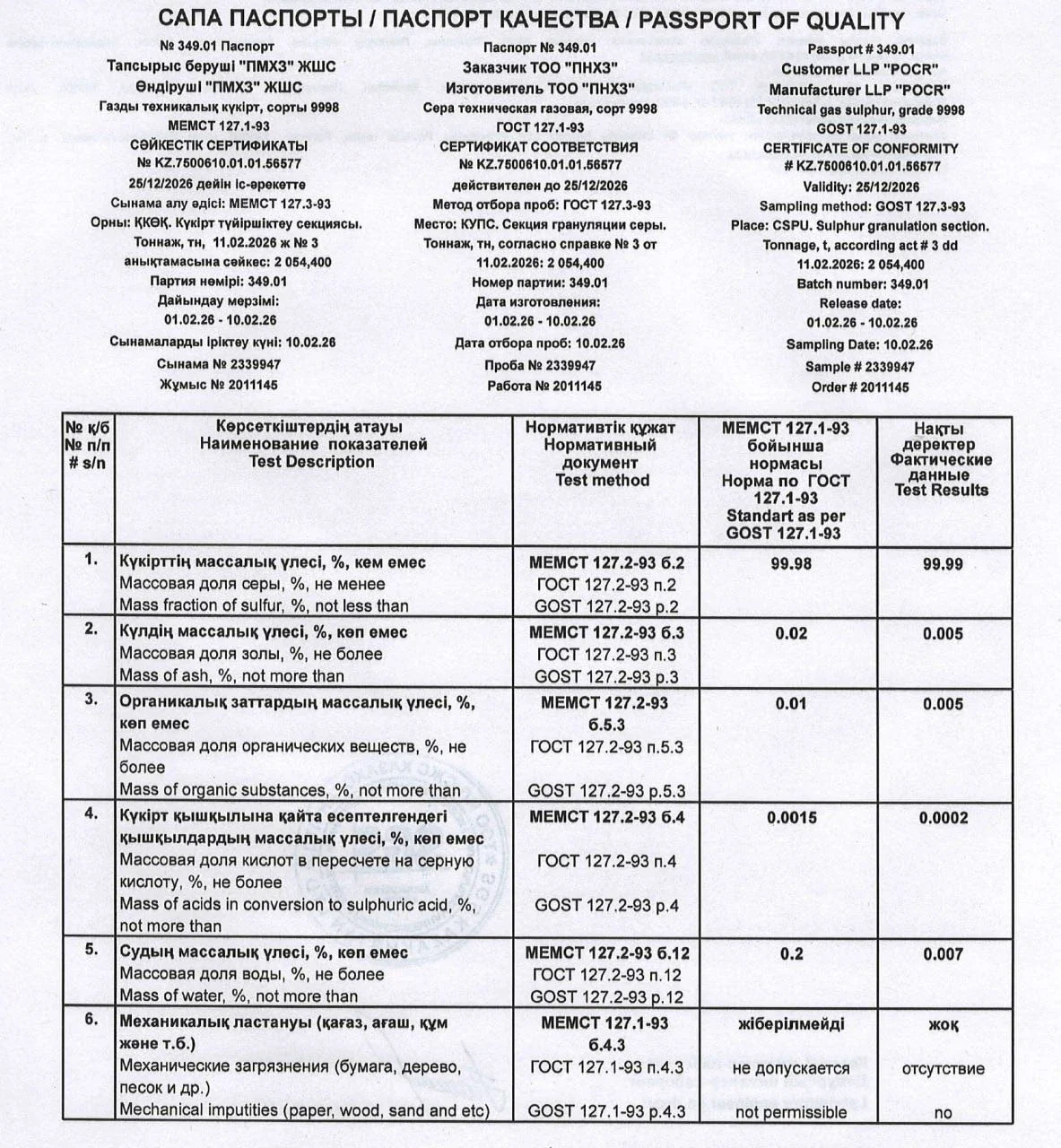
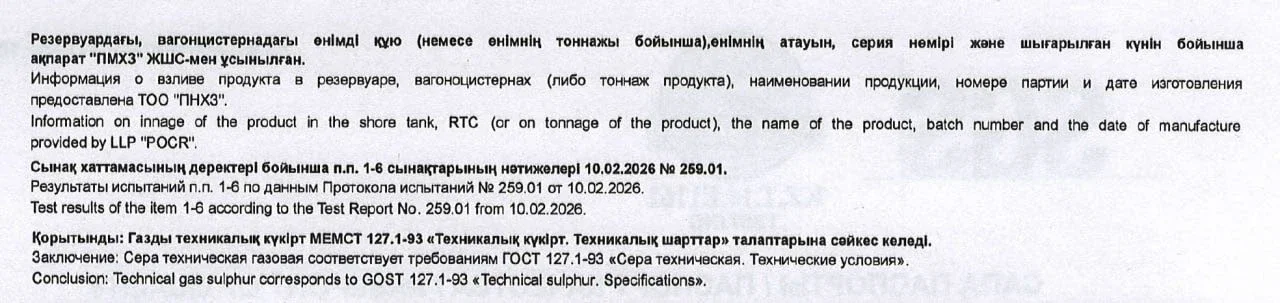
A quality passport ties the product not to a general specification but to a specific, tested lot. A separate passport is issued for each shipment; it is advisable to write this obligation into the contract on a per-lot basis. Independent inspection before loading (SGS or equivalent) and the taking of a sealed witness sample reduce the risk of documentary discrepancy in transactions paid under a letter of credit.
The Pavlodar Petrochemical Plant (PNHZ) is the largest crude oil refinery and petroleum products enterprise in north-eastern Kazakhstan; it is one of the country's three refineries and is wholly owned by National Company KazMunayGas JSC. Commissioned in 1978, the plant processes crude from the West Siberian fields and has an annual processing capacity of 6 million tonnes.
The plant's product range covers motor gasolines, diesel fuel, fuel oil, liquefied hydrocarbon gases, vacuum gas oil, bitumen grades and petroleum coke. Technical sulfur is part of that range: within the heavy oil residue processing complex, the sulfur production and sulfur granulation units are established as distinct process steps.
The modernisation programme completed in December 2017 brought two new process complexes on stream: the isomerisation and naphtha splitter complex, and the sulfur recovery unit complex. The existing primary and deep refining complexes and the delayed coking unit were rebuilt; these measures made it possible to produce K-4 class motor fuels in accordance with the Customs Union Technical Regulation (TR CU 013/2011).
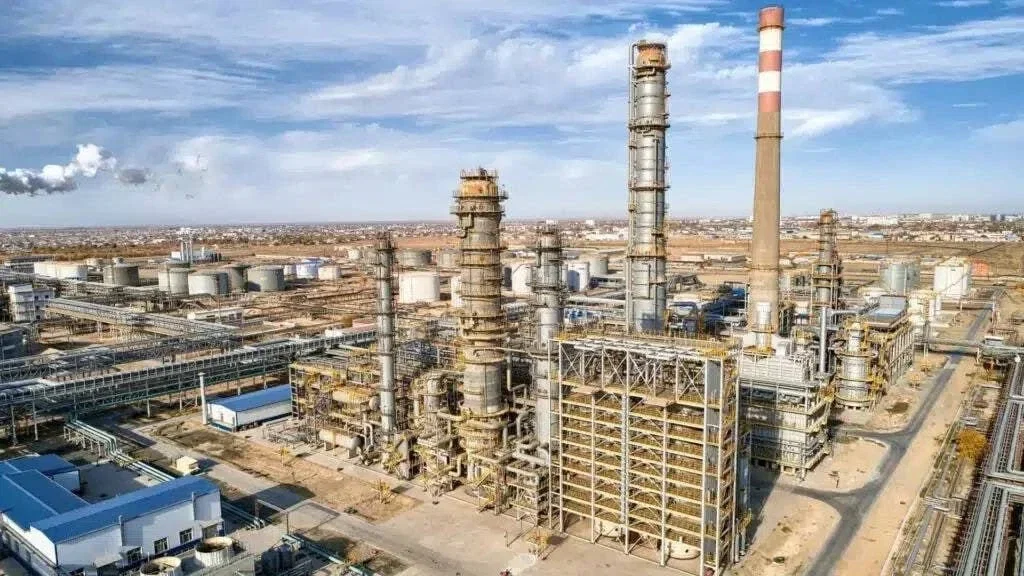
For a buyer the essential point here is this: sulfur is not waste collected at the plant but a product with its own recovery and granulation line. That is the precondition for lot-to-lot consistency and for a quality passport to be issued for every shipment. The plant's infrastructure includes commodity and raw material storage areas, a liquefied gas depot, and rail and road loading ramps.
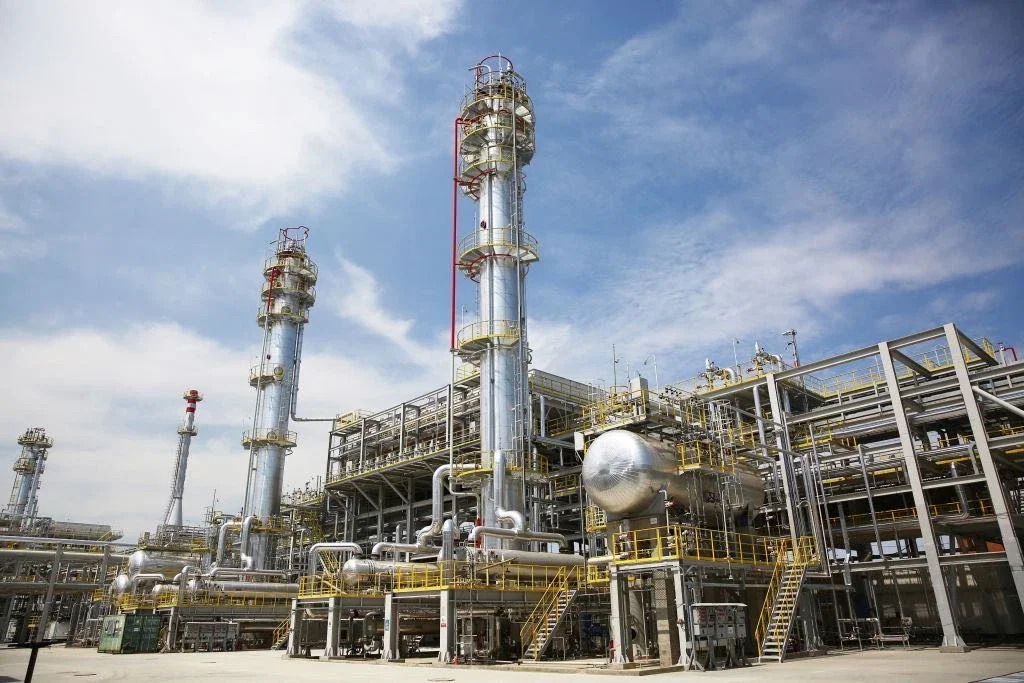
04 · A — The plant
Process units, site and storage views from the Pavlodar Petrochemical Plant.
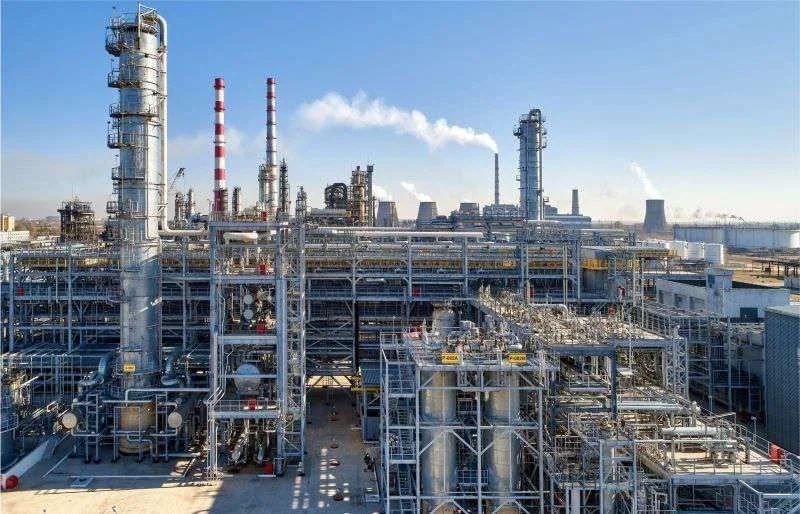
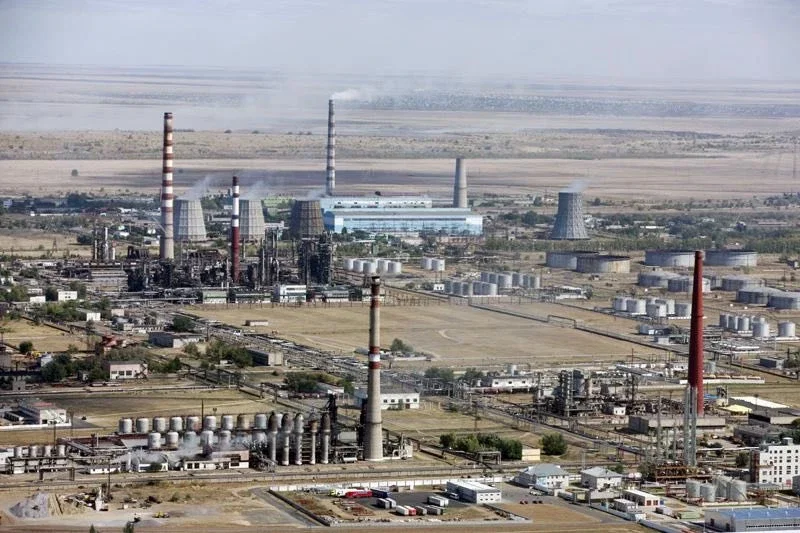
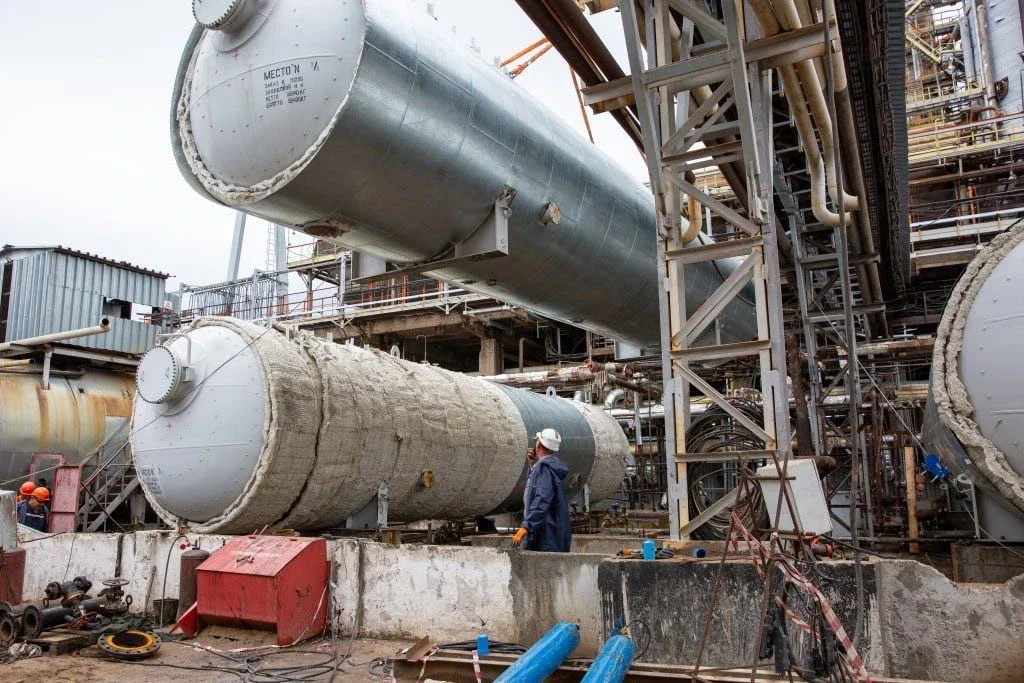
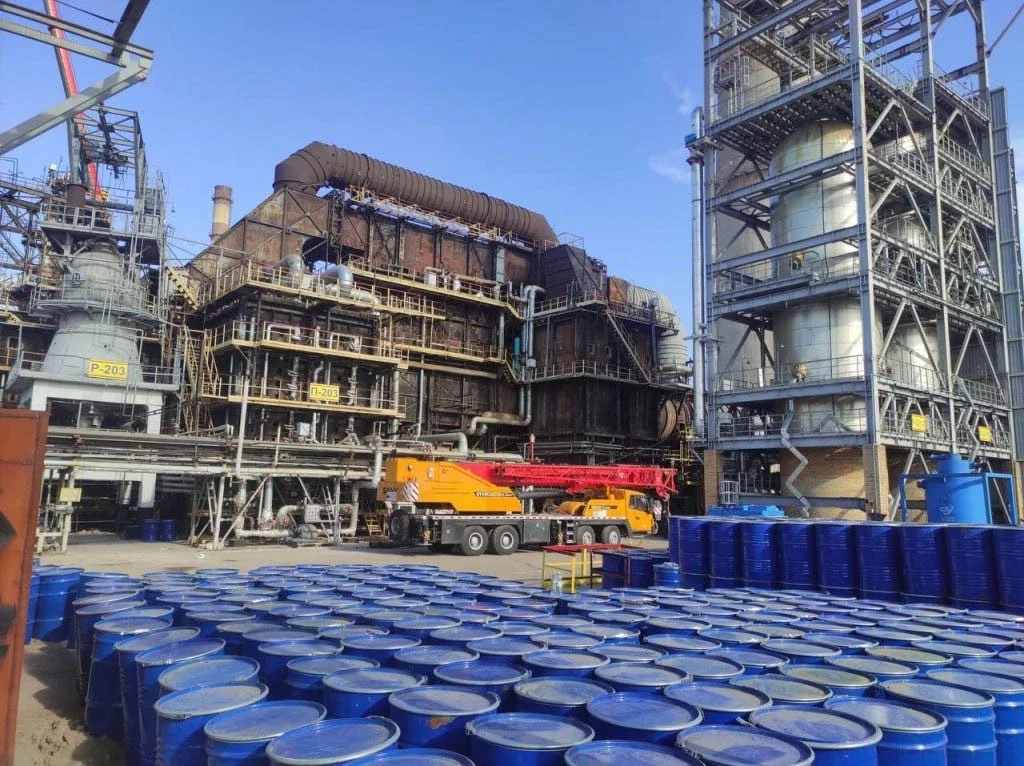
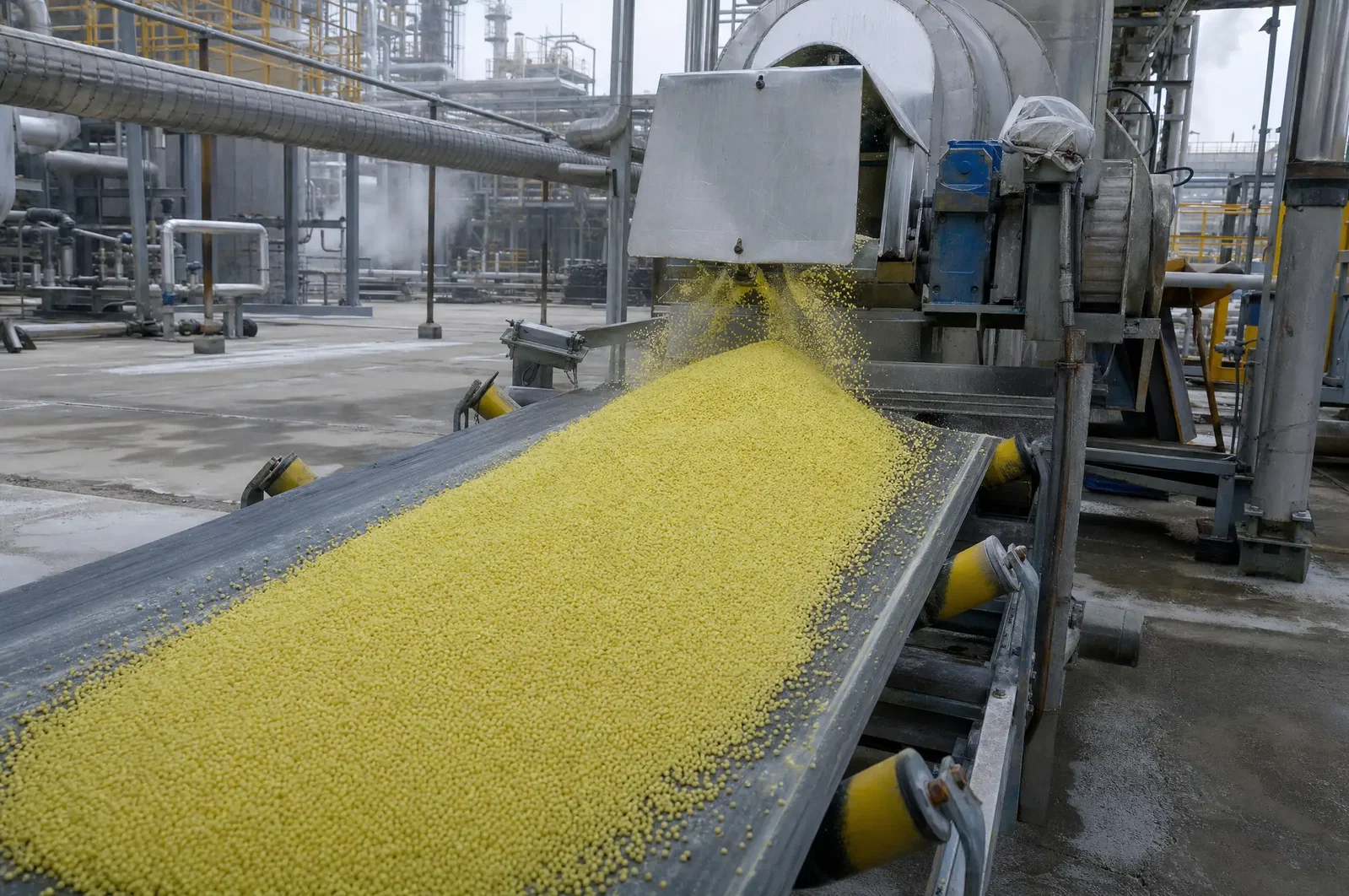
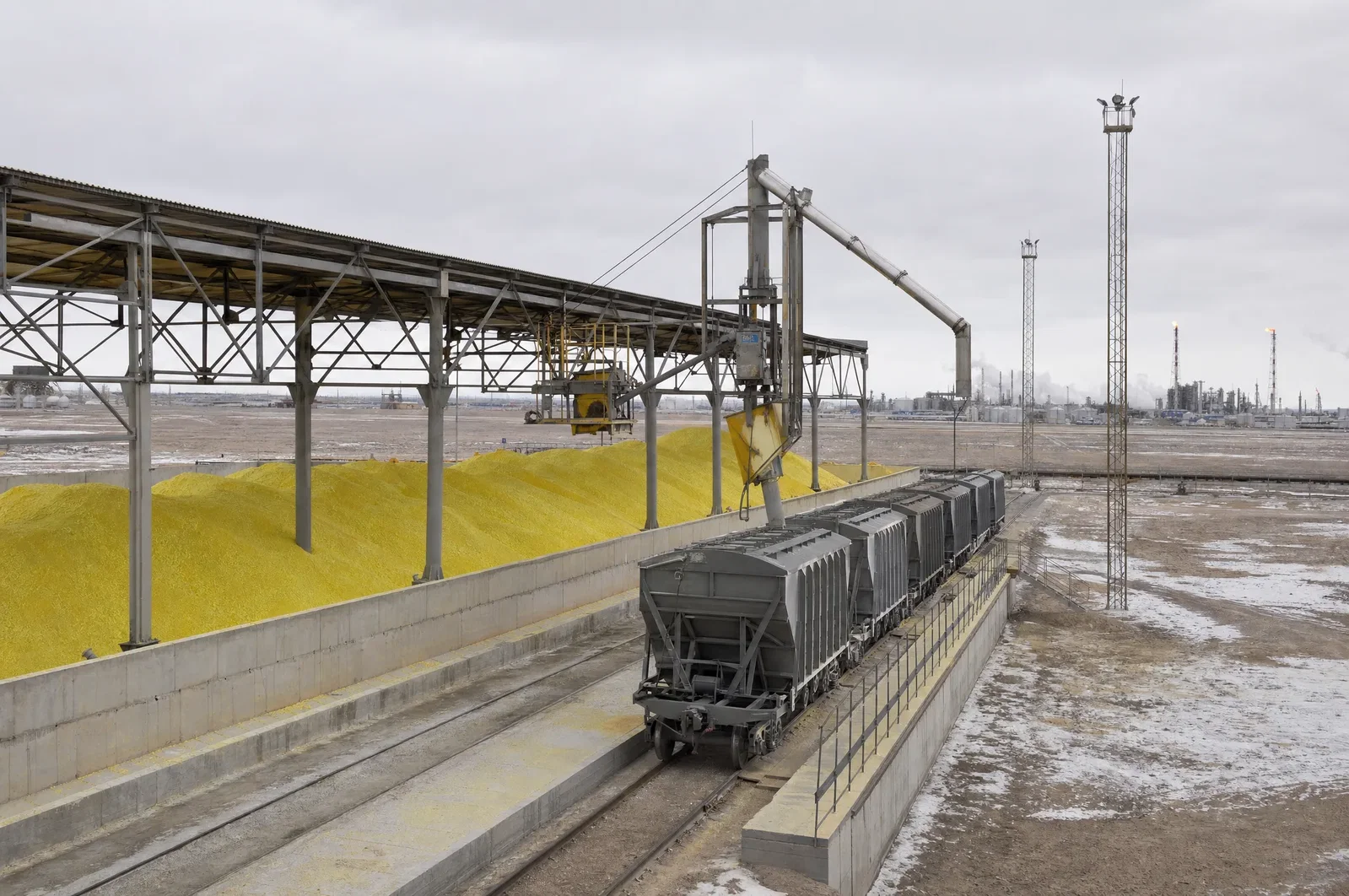
Process and site images are taken from the producer's file; the sulfur granulation and loading frames are representative.
The certificates below are issued in the name of LLP “Pavlodar Petrochemical Plant” and all carry the same scope: the production of petroleum refining products. Six of them were issued by an accredited certification body (TÜV Thüringen e.V. / TIC and MLK), and one under the State System of Technical Regulation of the Republic of Kazakhstan.
Quality Management System
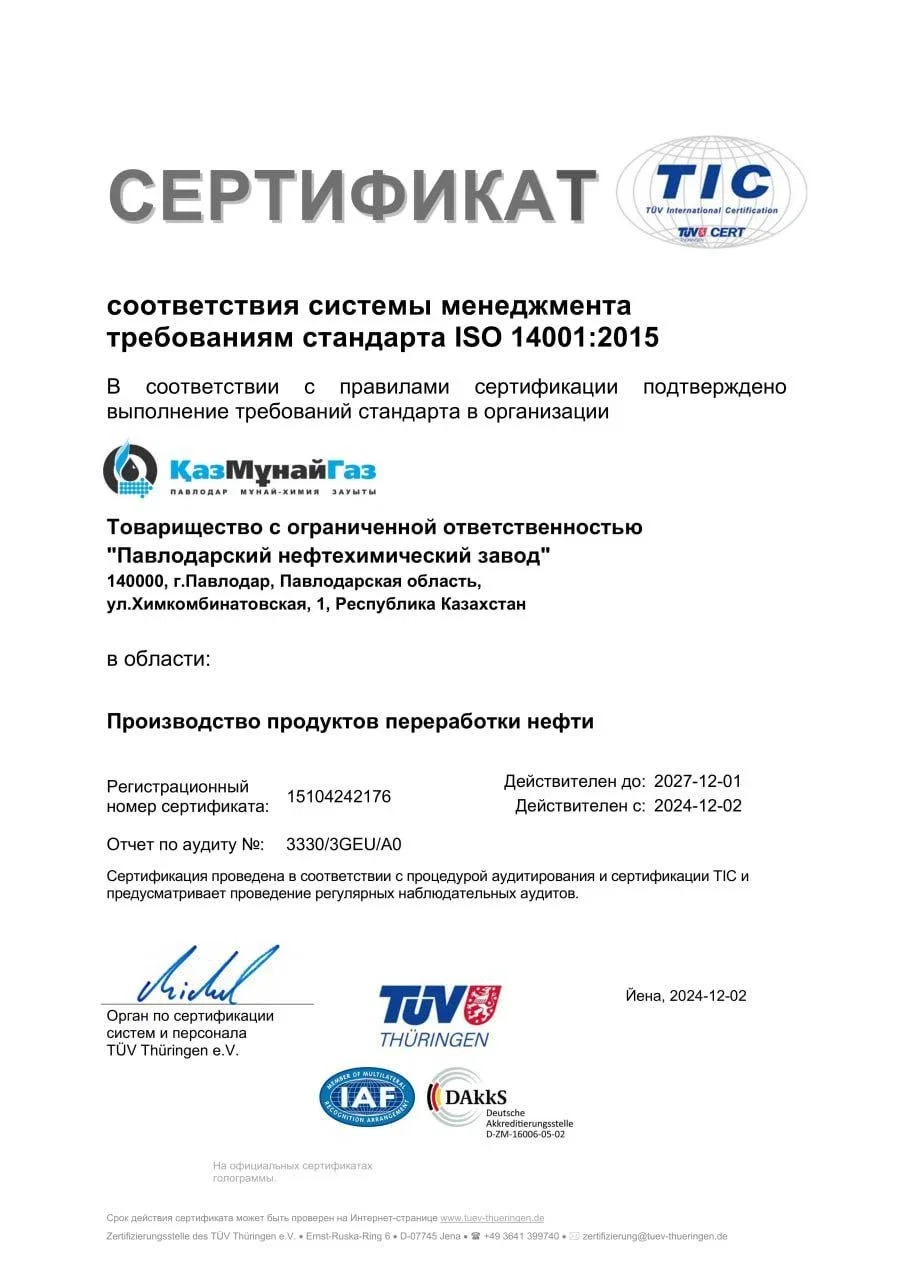
Environmental Management System
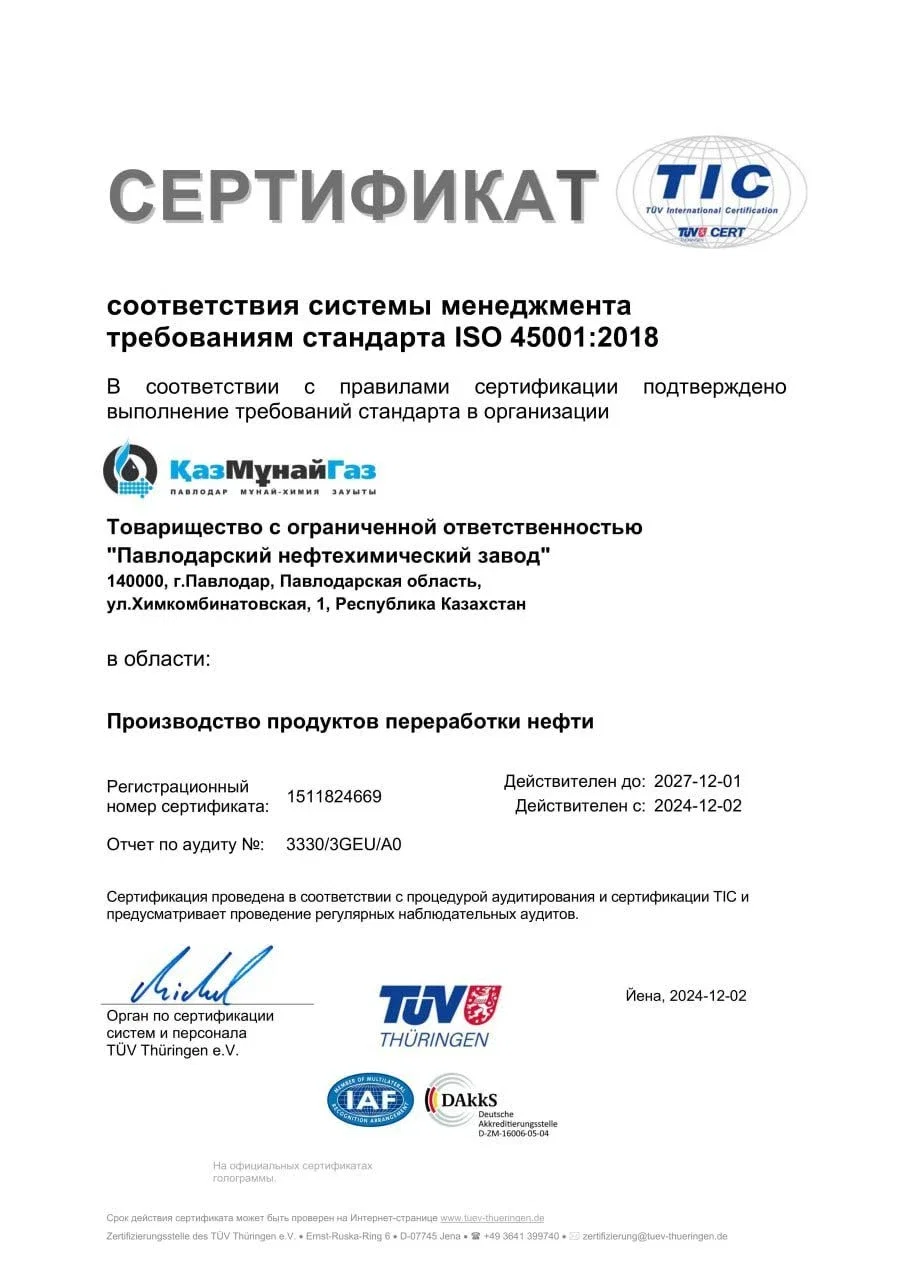
Occupational Health and Safety Management System
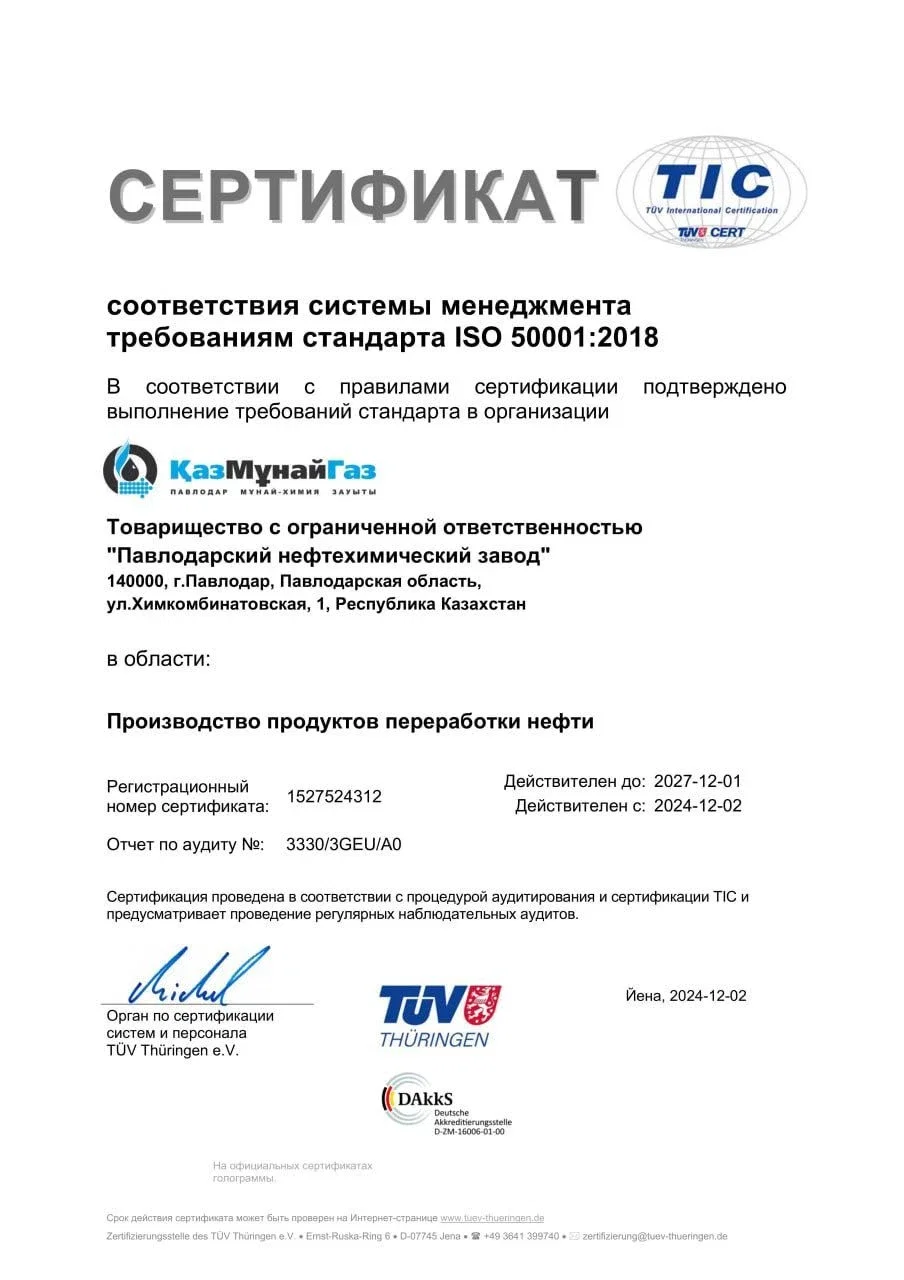
Energy Management System
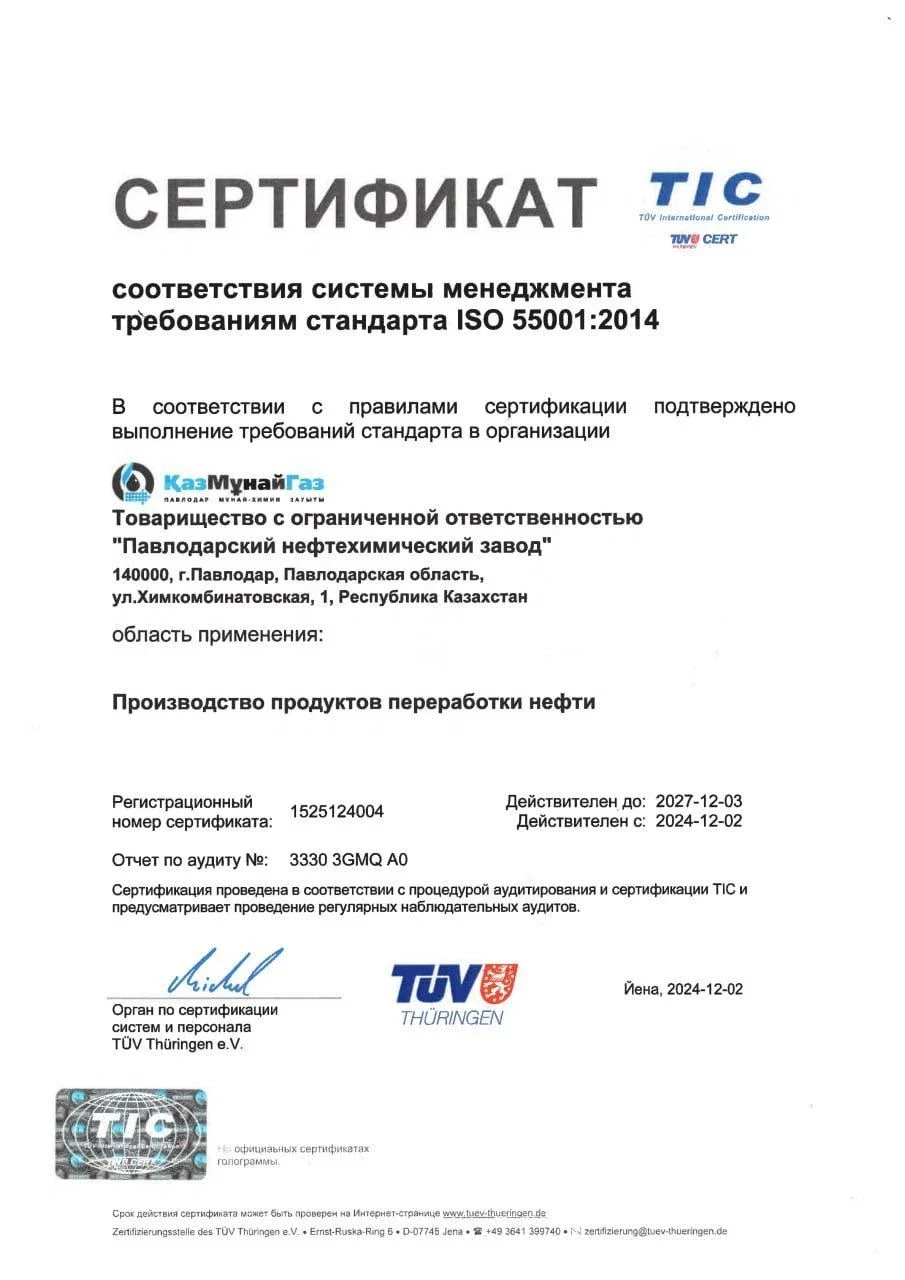
Asset Management System
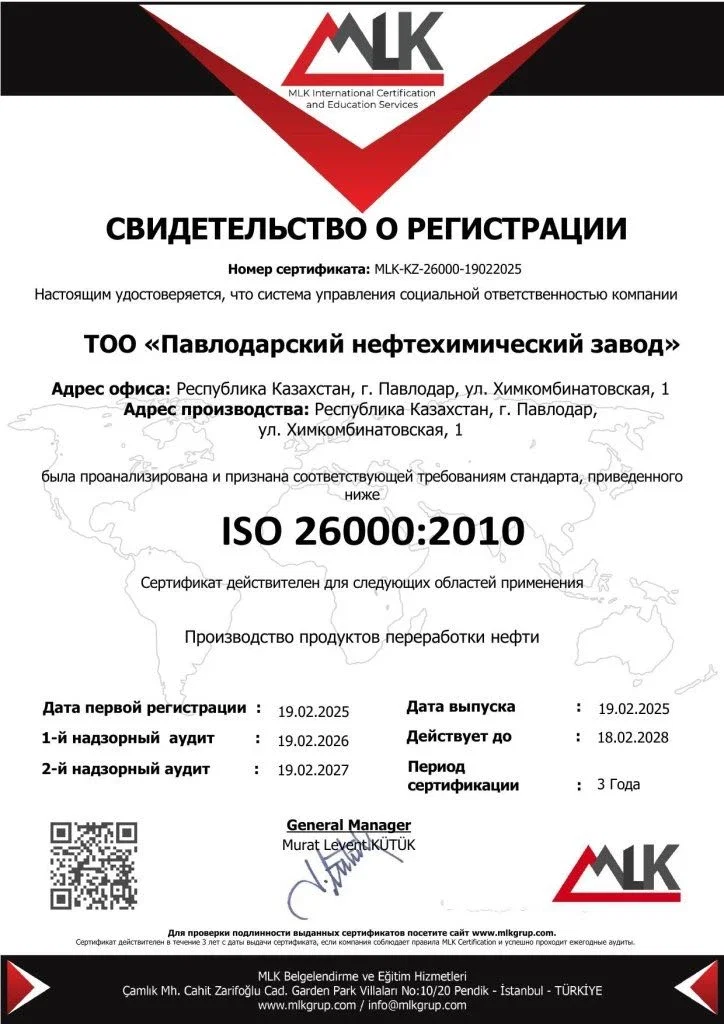
Social Responsibility Management
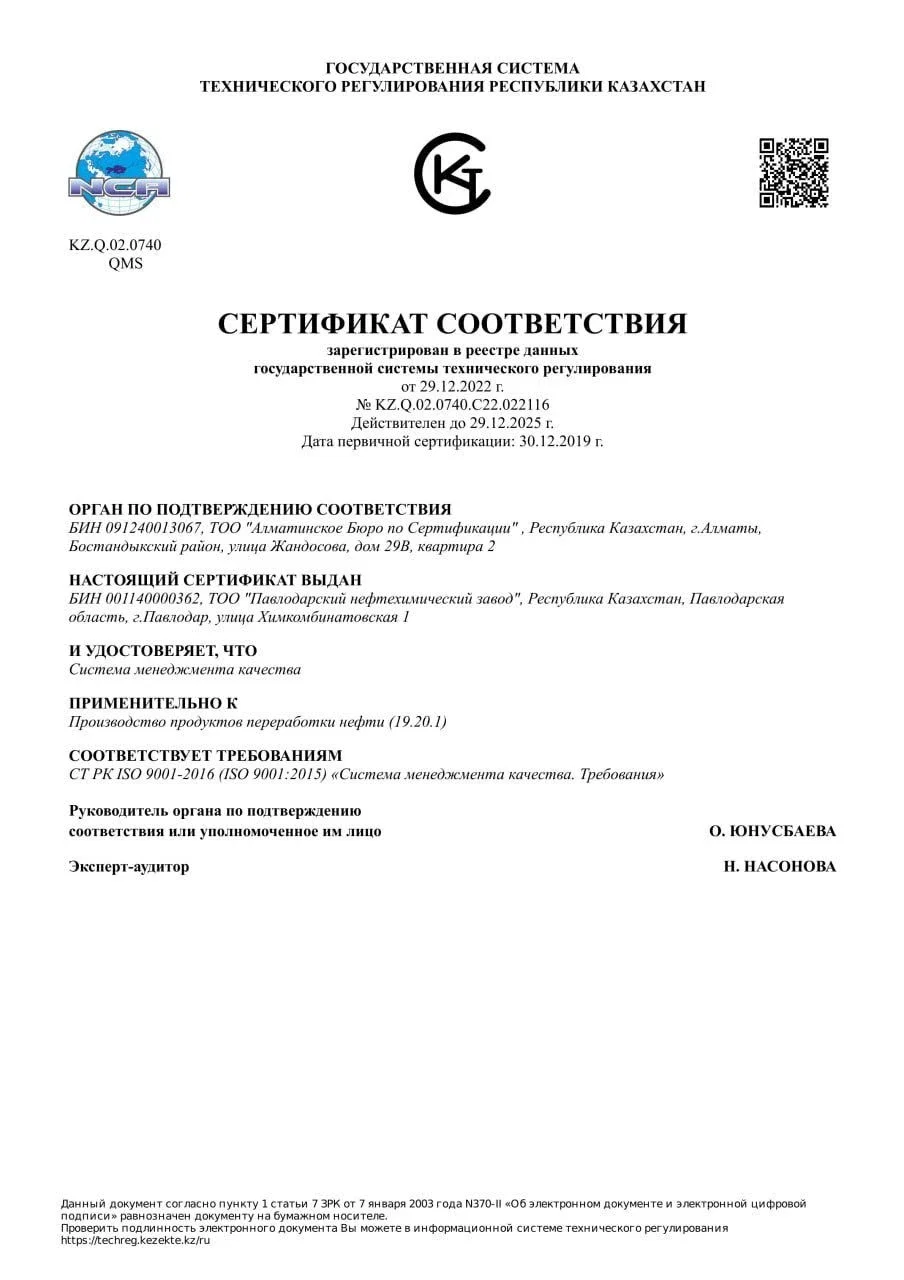
Certificate of Conformity — State System of Technical Regulation of the Republic of Kazakhstan
| Standard | Scope | Certifying body | Registration no. |
|---|---|---|---|
| ISO 9001:2015 | Production of petroleum refining products | TIC · TÜV Thüringen e.V. | 151002411815 |
| ISO 14001:2015 | Production of petroleum refining products | TIC · TÜV Thüringen e.V. | 15104242176 |
| ISO 45001:2018 | Production of petroleum refining products | TIC · TÜV Thüringen e.V. | 1511824669 |
| ISO 50001:2018 | Production of petroleum refining products | TIC · TÜV Thüringen e.V. | 1527524312 |
| ISO 55001:2014 | Production of petroleum refining products | TIC · TÜV Thüringen e.V. | 1525124004 |
| ISO 26000:2010 | Production of petroleum refining products | MLK International Certification | MLK-KZ-26000-19022025 |
| ST RK ISO 9001-2016 | Production of petroleum refining products | Almaty Certification Bureau | KZ.Q.02.0740.C22.022116 |
All certificates are issued for the same scope: the production of petroleum refining products. The TÜV Thüringen certificates are subject to regular surveillance audits; the MLK certificate provides for annual surveillance audits within its three-year certification period (19.02.2026 and 19.02.2027). The copy of the Kazakh national certificate of conformity held on file is valid until 29.12.2025; it is advisable to request a current copy from the producer at the contracting stage. The authenticity of the certificates can be verified by registration number on the certifying bodies' own verification pages.
For 1520 mm gauge, a standard gondola wagon has a load capacity of 68–71 tonnes and a volume of 75–88 m³. Since the bulk density of granulated sulfur is 1.05–1.25 t/m³, the limit is set by weight rather than by volume. In safe commercial operation 68–70 tonnes are loaded per wagon; an average of 69 tonnes is used in these calculations.
That figure is the multiplier for the entire programme. A forty-wagon train carries roughly 2,760 tonnes, and a long fifty-seven-wagon export train roughly 3,933 tonnes. A deviation of one tonne per wagon produces a difference of ten wagons across a 50,000-tonne monthly programme.
| Parameter | Value | Note |
|---|---|---|
| Wagon type | Gondola · 1520 mm | Kazakhstan / CIS gauge |
| Load capacity | 68–71 t | technical limit |
| Volume | 75–88 m³ | not the binding constraint for granulated sulfur |
| Practical loading | 68–70 t | 69 t average used in the calculation |
| 40-wagon train | ≈ 2,760 t | 69 t × 40 |
| 57-wagon train | ≈ 3,933 t | 69 t × 57 · long export train |
| Train length · 40 wagons | 600–650 m | 14 m per wagon + locomotives |
| Train length · 57 wagons | 850–950 m | 14 m per wagon + locomotives |
The wagon numbers in the table are the requirement for a single trip; they are not the fleet size. Wagons will be en route, waiting for the ferry, standing at the port and returning. The actual fleet requirement is calculated together with turnaround time in the next section.
At 50,000 tonnes a month this is no longer a “one-off deal” but a fully fledged export programme. That cadence requires a continuous window at the loading station, continuous coordination with KTZ (Kazakhstan Railways), stable fleet management and uninterrupted work with the port.
The most realistic route is the Middle Corridor: Kazakhstan → Caspian Sea → Azerbaijan → Georgia → Batumi. The cargo crosses only two international borders; legally and operationally, however, the chain consists of considerably more segments. In other words, this is a multimodal international chain in which four to five operators are engaged.
| Operator | Role | Criticality |
|---|---|---|
| KTZ — Kazakhstan Railways | Loading station allocation, wagon movement, domestic transit | high |
| Port of Aktau / Kuryk | Pre-ferry wagon acceptance and holding yard | medium |
| Caspian ferry operator | Sea crossing with wagons, sailing schedule and slot allocation | critical |
| ADY — Azerbaijan Railways | Alat / Baku → Georgian border transit | medium |
| Georgian Railways | Border → Batumi / Poti line | medium |
| Batumi terminal | Discharge, storage, vessel loading | high |
Gondola wagons do not always cross the sea without difficulty: ferry acceptance requires approved wagons, not every wagon is taken on the Caspian ferries, and shortages of platform or holding-yard capacity occur from time to time. A realistic plan requires at least the following: a forwarder, a TITR forwarder, agreements with the port, ferry storage, fleet management and wagon coordination.
07 · A — Bottleneck
The Caspian Sea is where all of the arithmetic begins to break down.
A rail ferry carries roughly 28–54 wagons depending on its type. A single train of yours may therefore be split across two ferry sailings, or have to wait for the whole queue. Queues, ferry shortages, weather-related delays, the planning interval and the priority given to oil and container traffic all drive the variability of this leg. A volume of 50,000 tonnes a month places a serious load on the corridor, particularly in the high season when grain, containers, oil and Chinese transit all peak.
For 50,000 tonnes a month, roughly 725 wagons are loaded in a single trip. That, however, is not the whole fleet. At any moment wagons will be en route, waiting for the ferry, standing at the port and running back empty. The total time spent across these four states determines how many wagons you actually need to have.
For the Kazakhstan → Batumi → return route via TITR, a realistic turnaround time is 25–40 days, and at times longer. A steady programme of 50,000 tonnes a month may therefore require approximately 1,000–1,400 gondola wagons in constant circulation — roughly twice the single-trip requirement.
| Monthly volume | Wagons per trip | Turnaround time | Fleet in constant circulation |
|---|---|---|---|
| 25,000 t | ≈ 362 | 25–40 days | calculated from the turnaround time |
| 35,000 t | ≈ 507 | 25–40 days | calculated from the turnaround time |
| 50,000 t | ≈ 725 | 25–40 days | ≈ 1,000–1,400 wagons |
Fleet size is one of the largest fixed cost items in this business, and every single day of improvement in turnaround time directly reduces the fleet requirement. Securing Caspian slots and discharge speed at Batumi are therefore items that deserve as much care in the contract as price does.
Granulated sulfur can also be carried in an open gondola wagon; tarpaulin, load distribution and dust requirements, however, reduce the practical loading weight. The equipment designed for this cargo is the closed hopper wagon with side discharge: it protects the product from the weather, speeds up discharge and therefore shortens wagon turnaround time.
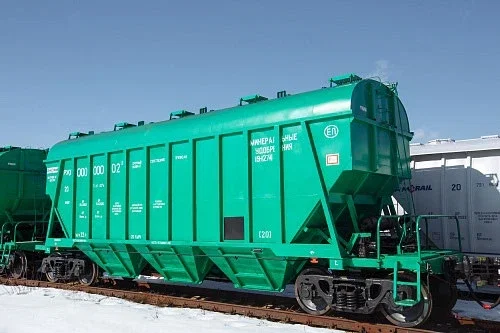
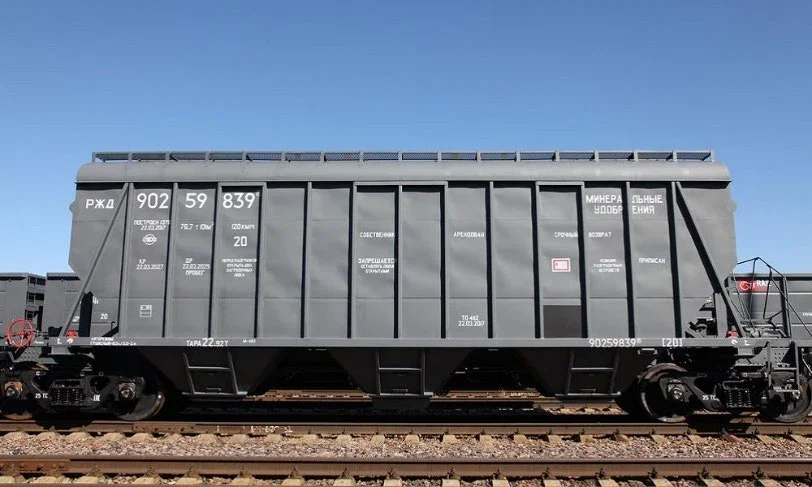
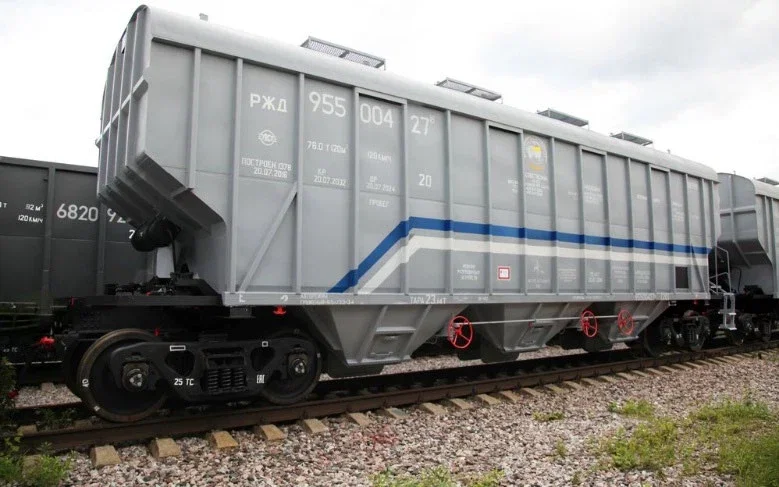
| Property | Value |
|---|---|
| Model | 19-9741/MБ |
| Model number | 1094 |
| Designation | Hopper wagon for granulated sulfur |
| Model feature | Closed hopper with side discharge |
| Specialisation | Granulated sulfur |
| Body material | 09Г2С, 09Г2Д, 09Г2, 09Г2СД-12 |
| Number of axles | 4 |
| Track gauge | 1520 mm |
| Tare weight (max.) | 22.0 t |
| Load capacity | 72.0 t |
| Volume | 74.0 m³ |
| Maximum static load from wheelset on rail | 235.0 kN |
| Length over automatic coupler axes | 12,920 mm |
| Start of series production | 2015 |
| Standard service life | 24 years |
Equipment selection is not only a transport decision but also a turnaround-time decision. Compared with an open gondola, the closed hopper speeds up discharge and lowers the risk of moisture ingress; on the other hand, securing specialised wagons is harder than securing general-purpose wagons, and the requirement for ferry-approved wagons must be verified separately.
The real attraction of Batumi is that Handymax and Supramax class vessels can be loaded there. That means the cargo can be carried through Suez to the Indian Ocean and on to Indonesia — in other words, where the rail chain ends, the economics of ocean-going commodity shipping begin.
This also raises a critical question, however: Kazakhstan → Batumi → Indonesia is a long and expensive route for a low-margin commodity such as sulfur. Every link in the chain has to be justified, because on the buyer's side Chinese, Middle Eastern and at times Russian sulfur may be cheaper in logistics terms.
This section is not a declaration of preference but a cost question. Whether the Batumi route is defensible depends on the total delivered cost per tonne remaining comparable with the offers the buyer receives from alternative origins. The next section shows how that cost is distributed.
Where the buyer's documents expressly stipulate “non-sanctioned origin / port of loading”, this usually points to one of three things: the compliance policy of an Asian bank, international compliance pressure, or an end buyer with strict compliance criteria. In all three cases origin is a screening criterion that comes before price in the negotiation.
At this point the advantage of Kazakh origin is clear and documentable: clean origin, transparent documents, no use of a Russian port, no Russian bill of lading and no re-export ambiguity. For many banks and Asian buyers this is an advantage important enough to offset differences in logistics cost.
| Buyer requirement | How it is met in this supply | Supporting document |
|---|---|---|
| Non-sanctioned origin | Produced in the Republic of Kazakhstan | Certificate of origin · producer declaration |
| Non-sanctioned port of loading | Shipped out of Batumi (Georgia) | Bill of lading · port clearance documents |
| Conformity with the product specification | GOST 127.1-93 grade 9998 · 99.99% measured | Quality passport · test report |
| Producer management system certificates | ISO 9001 / 14001 / 45001 / 50001 / 55001 / 26000 | Accredited certification certificates |
| Independent determination of quantity and quality | Inspection at loading and discharge is recommended | SGS / draft survey · witness sample |
This table is not a legal opinion. Sanctions regimes change, and the final assessment is made by the bank financing the transaction and by the buyer's own compliance function. The purpose of this dossier is to show that the documents on which that assessment will rest can be presented in advance and in full.
This dossier does not quote a price. The price of sulfur moves with fuel, freight, ferry slot costs and the demand cycle; a figure printed in a technical document is out of date before it is read. What can be set out in advance is which items the cost is made up of, and on which basis the offer will be written.
Sulfur is a low-margin commodity. The difference between FOB Kazakhstan and CFR port of destination is the sum of rail, the Caspian ferry, Azerbaijani transit, Georgian transit, Batumi handling and ocean freight. None of these items adds value to the product; all of them are friction. Every offer should therefore be quoted separately on both bases.
| Basis | Where the obligation ends | What is included |
|---|---|---|
| FOB | Loading on board at the port of loading | Production, domestic rail and port of loading charges. The sea leg is for the buyer's account. |
| CFR | Port of destination | FOB items + transit + terminal + ocean freight. Insurance is for the buyer's account. |
Payment in this chain cannot be structured on a letter of credit alone. The railway administrations, the ferry operator and the port terminal all demand their charges before the cargo moves, whereas a letter of credit pays after documents have been presented. An advance is therefore provided for on the first shipment, to cover the logistics costs that arise along the chain; the advance is not a profit item but working capital committed up front so that the cargo can move without interruption. The contract must state clearly which items the amount will be set off against and how it is to be evidenced.
A practical note for the buyer: ask for both bases on the same page. An offer quoted on the delivered basis alone conceals how much of the figure is product and how much is logistics, and cannot be compared with offers from alternative origins.
The set of documents presented by the buyer's side is coherent and technically sound: while non-circumvention, confidentiality, compliance and strict adherence to the letter of credit are required, the letter of intent itself is drafted as non-binding, guarantees no volumes and leaves price to be agreed. This is the customary structure of an experienced commodity desk: maximum control, minimum early obligation.
The letter of credit clause is also properly drafted: a 100% irrevocable, non-transferable documentary credit payable at sight. Making it non-transferable is a deliberate choice. The requirement of “strict compliance of documents” does, however, open an area of banking risk: in bulk sulfur trading the number of documents to be presented is high, and a single discrepancy can delay payment.
The present stage is therefore commercially real but still “soft”. What is needed to move forward is not further specifications but visibility of the financing and of the end buyer. By way of reciprocity, the seller's side likewise does not disclose the source and the full production chain at this stage.
| Document | What it evidences |
|---|---|
| 01Bill of lading (B/L) | That the cargo was loaded on board, and the chain of title |
| 02SGS / inspection report | Independent determination of quantity and quality |
| 03COA / quality passport | Conformity of the lot with GOST 127.1-93 |
| 04Packing and weight certificates | That the invoiced quantity matches the actual cargo |
| 05Certificate of origin | The country of production — critical for compliance |
| 06Charter party details | The terms of the contract of carriage by sea |
| 07Insurance policy | The scope of cover on the cargo |
| 08Laycan / notice of readiness | Compliance with the loading window |
| 09Draft survey | The tonnage loaded, measured from the vessel |
This assessment is not a statement of mistrust but the standard reciprocity logic of commodity trading: one party opens its source and the other its financing, at the same time and to the same degree. Once the three headings above are satisfied, the file is ready to move to a firm offer and then to the sale and purchase agreement (SPA).
This supply chain fails in a small number of predictable ways. The register below is ordered not by likelihood but by the cost of the failure, because in this corridor the rarest failures are the ones that write off an entire shipment. Most of the controls are contract clauses rather than operations.
The typical mistake of a first commodity import is to negotiate hard on the price per tonne and loosely on everything else. A concession won with difficulty on price is measured in single digits per tonne; a wetted lot or a rejected set of documents is measured by the whole shipment.
End of the dossier
The next step isa firm offer
This dossier answers the technical and logistical questions that come before an order. What it deliberately does not do is quote a price; that requires a stated requirement — grade, monthly tonnage, first shipment window and port of delivery. Once those four headings are settled, the offer is drawn up in parallel on both the FOB and the CFR basis.
This dossier is a briefing, not a contract. The technical values are taken from the producer's documents and the quality passport, and the logistics calculations are based on the study dated 21 May 2026. Should anything set out here conflict with a signed offer or contract, the signed document prevails.