



International supply of hydraulic binder
GOST 31108-2020Portland Cement
A complete technical briefing on Portland cement — what the material is, what the five CEM families actually guarantee, which four grades the Turkish market buys in volume, and how bulk tonnage reaches a buyer in Türkiye from the works of the Russian Federation.

- Standard
- GOST 31108-2020
- equivalent to EN 197-1
- Bulk lot
- 5,000–30,000 t
- per shipment
- Strength class
- 42.5
- across all four priority grades
- Delivery
- Black Sea
- to port, performed by the supplier
Four grades, one corridor, and a standard the buyer already knows
In August 2026 Gaz-Trans International was asked a narrow question: what would it take to supply Russian-quality cement to Türkiye at scale, and — in a later phase — onward into the European Union. This dossier is the answer, and it begins by narrowing the field. Russian works produce the full modern range, from CEM 0 through CEM V, alongside a shelf of special binders. Almost none of that range is relevant to a Turkish buyer.
Four grades carry the volume. CEM I 42.5N is the most versatile and the most easily resold. CEM I 42.5R is what precast yards and ready-mix plants ask for when early strength decides the pour cycle. CEM II/A-L 42.5N offers the best balance of cost against performance. CEM III/A 42.5N is the grade that port, tunnel and hydraulic engineering work is written around. Everything that follows exists to explain why those four, and not the others.
The commercial position is equally narrow. Sanctions have closed most of the European outlet for Russian cement, and producers have turned toward the CIS, the Caucasus, Central Asia and the Middle East. Türkiye sits at the near edge of that redirection — a short sea leg from the loading ports, with a construction sector large enough to absorb contracted volume rather than occasional spot parcels.

Two delivery bases exist in this trade and they must never be confused. FOB names the cargo at the loading port, with the buyer taking it from the ship's rail onward. CFR names it delivered to a Turkish port, with the sea leg included. The two are separated by the entire cost of moving a low-margin cargo across a sea. Section 11 sets out how a quotation is built on both.
A powder that sets under water, and the four minerals that make it do so
Cement is not a mixture that dries. It is a hydraulic binder — a finely ground powder that reacts chemically with water, forms new crystalline and gel phases, and hardens under water as readily as in air. Everything a buyer pays for is contained in that reaction and in how fast it proceeds.
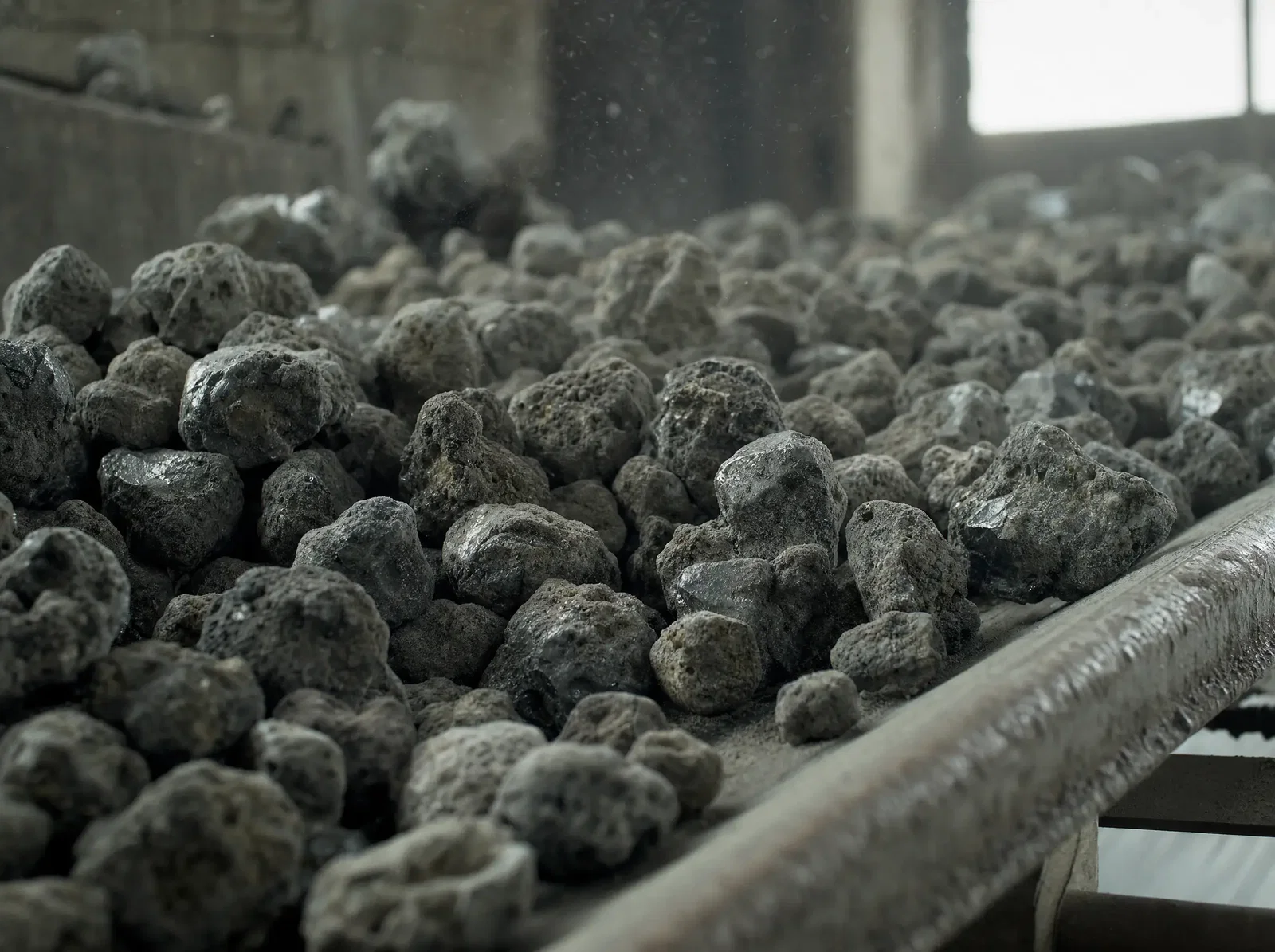
The powder is made by burning a precisely proportioned meal of limestone and clay to roughly 1,450 °C. At that temperature the charge partially melts and re-forms as clinker: dark, glassy nodules the size of gravel. Clinker is then ground together with three to five per cent gypsum, which is what stops the cement from flash-setting in the mixer. Mineral additions, where the standard permits them, are inter-ground at the same stage.
Four clinker minerals do the work, and their proportions decide almost everything a specification cares about: how early strength arrives, how much heat is released while it does, and how the hardened paste behaves against sulfate and sea water. A CEM I 42.5R and a CEM III/A 42.5N differ far less in what they contain than in how those contents are balanced and diluted.
| Phase | Notation | Typical share | What it governs |
|---|---|---|---|
| Alite · tricalcium silicate | C₃S · 3CaO·SiO₂ | 50–70% | Early strength and most of the 28-day figure. The principal source of hydration heat. |
| Belite · dicalcium silicate | C₂S · 2CaO·SiO₂ | 15–30% | Late strength, from 28 days out to years. Reacts slowly and releases little heat. |
| Tricalcium aluminate | C₃A · 3CaO·Al₂O₃ | 5–10% | Setting behaviour and the first hours of heat. The phase sulfates attack — hence sulfate-resisting grades cap it. |
| Ferrite phase | C₄AF · 4CaO·Al₂O₃·Fe₂O₃ | 5–15% | The grey colour of ordinary cement. Contributes little to strength; its absence is what makes white cement white. |
| Gypsum · added at grinding | CaSO₄·2H₂O | 3–5% | Retards C₃A and prevents flash set. Not a clinker phase — an interground control on one. |
Fineness is the fifth variable and it rarely appears on an invoice. Ordinary Portland cement is ground to a specific surface of roughly 300 to 400 m²/kg; rapid-hardening grades are ground finer still. Finer cement gains strength faster, releases heat faster, and consumes more electricity per tonne — which is why the R in a grade designation is a milling decision as much as a chemical one.
Six operations stand between a limestone face and a tonne of cement
Cement production is a sequence of six operations, and only one of them involves fire. The other five exist to make the fire predictable.
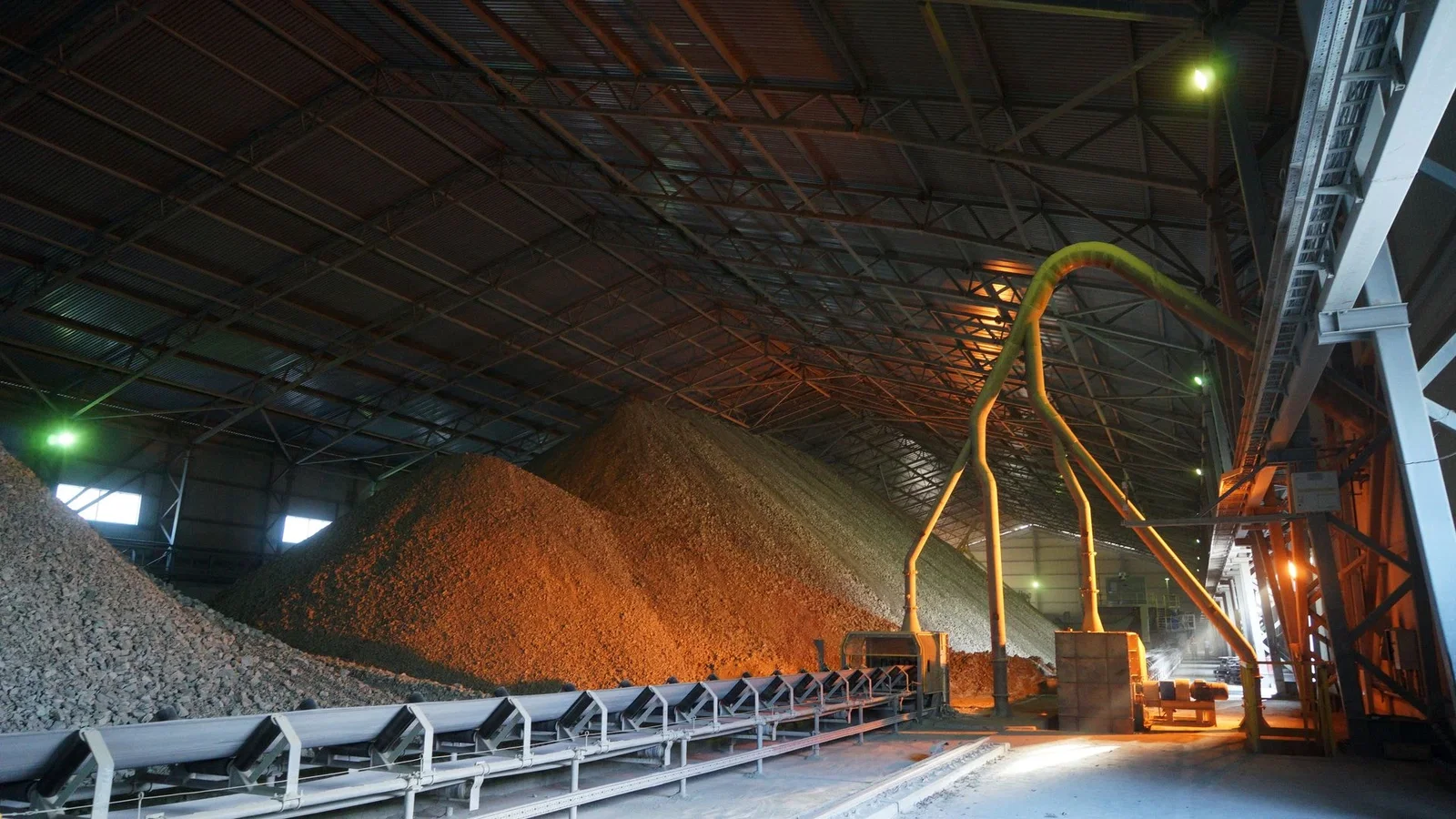
Between eighty and ninety per cent of the raw meal is limestone; the balance is clay or shale supplying silica and alumina, corrected with iron ore, sand or bauxite where the deposit falls short. The meal is dried, ground to a flour and homogenised before it enters the preheater tower — a stack of cyclones that recovers heat from the kiln gases and calcines most of the limestone before the material ever reaches the rotary kiln.
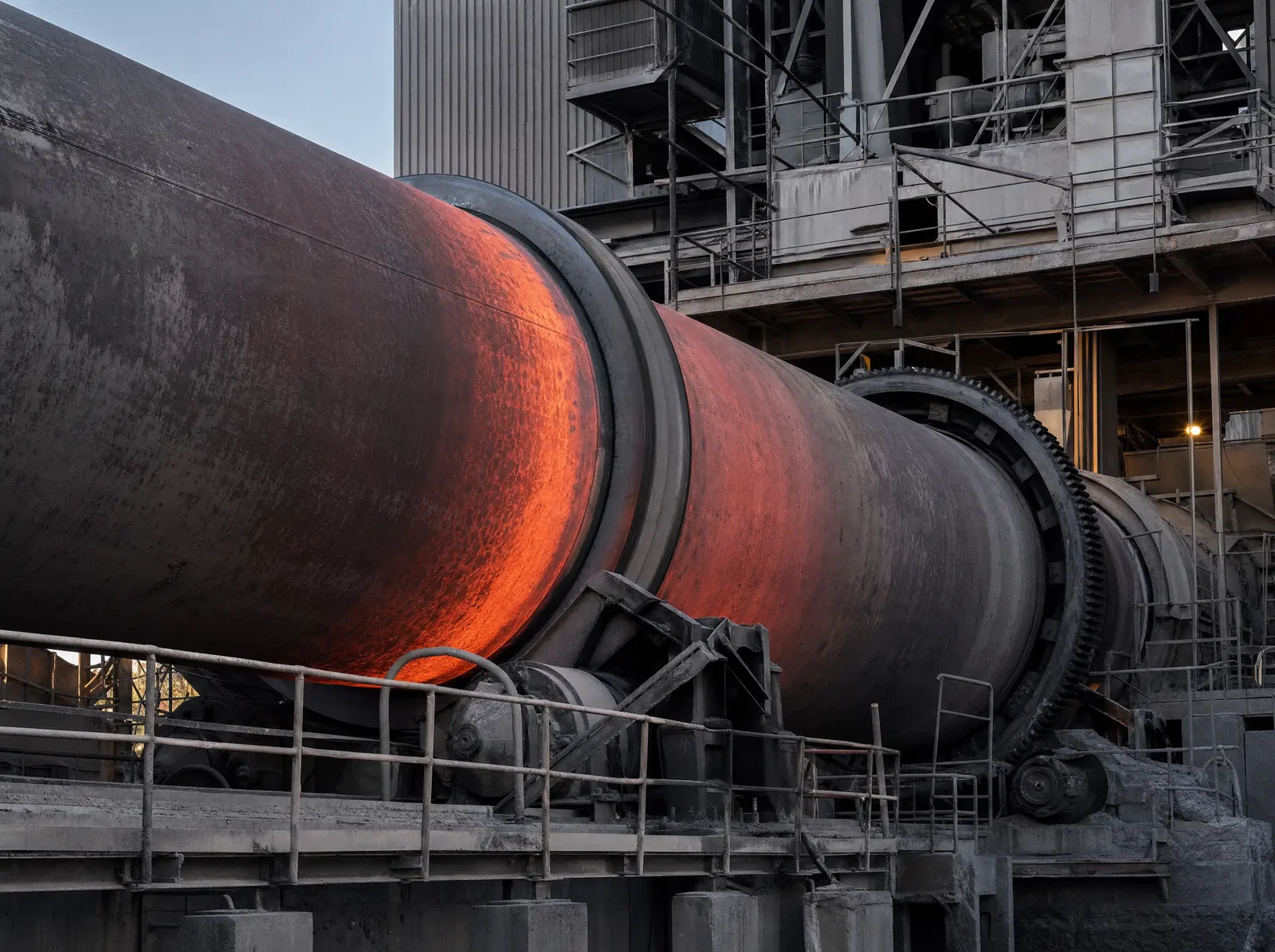
In the kiln the charge climbs to roughly 1,450 °C, partially melts and re-forms as clinker. It is then quenched in a grate cooler — quickly, because slow cooling coarsens the crystal structure and costs strength — and stored. Grinding is the last operation and the most electricity-hungry: clinker, gypsum and any permitted mineral addition are milled together to whatever fineness the grade requires.
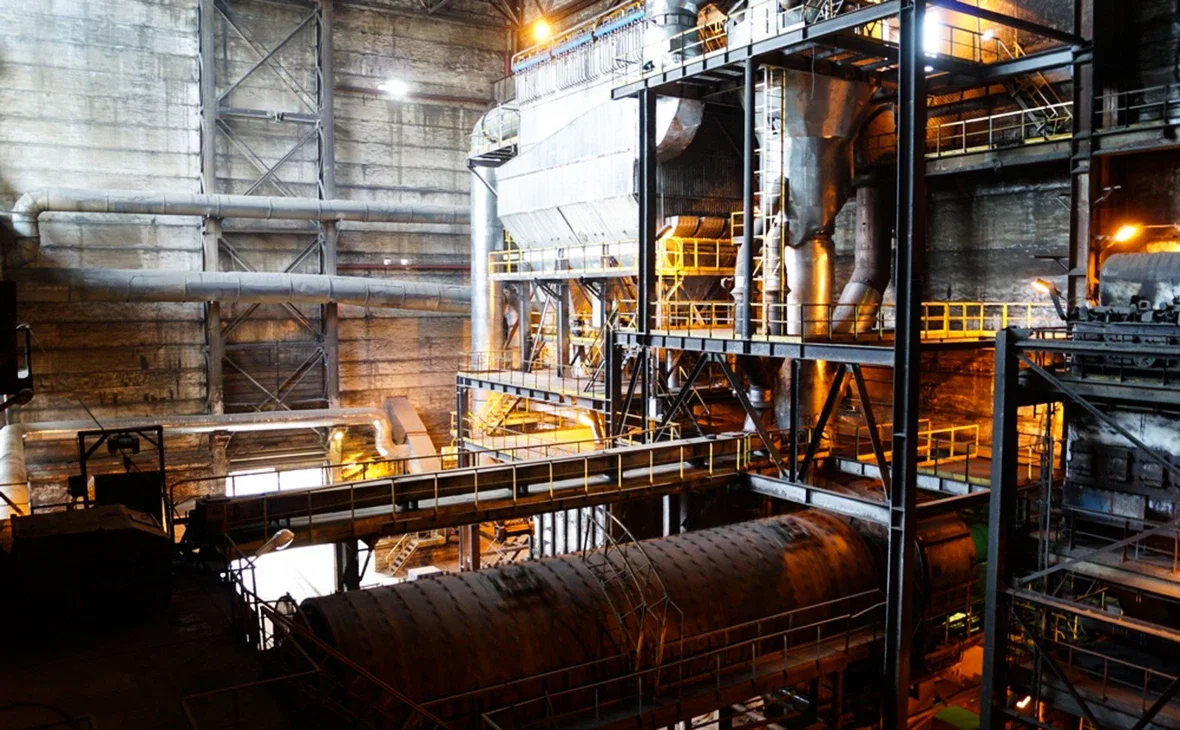
- 01Quarrying & crushingLimestone is blasted, crushed and conveyed. Grade control begins at the face — the variability of the deposit sets the ceiling on everything downstream.
- 02Pre-blending & raw grindingLayered stockpiles are cut across to average the chemistry, then dried and ground to a raw meal finer than table salt.
- 03HomogenisationContinuous blending silos hold the meal to its target lime saturation factor before it is fed to the tower.
- 04PyroprocessingPreheater cyclones and a precalciner strip CO₂ from the limestone; the rotary kiln takes the charge to ~1,450 °C, where it sinters into clinker.
- 05Clinker coolingGrate coolers quench the nodules and return hot air to the kiln. Cooling rate governs alite crystal size — and therefore reactivity.
- 06Cement grinding & dispatchClinker, gypsum and additions are milled to the target fineness, stored by grade in silos, and loaded to bulk tanker, big bag or sack.
- Sintering temperature
- ≈ 1,450 °C
- Clinker content, CEM I
- 95–100%
- Thermal energy
- 3.0–3.8 GJ/t clinker
- Electrical energy
- 90–130 kWh/t cement
The economics follow the physics. The greater part of what an exported tonne costs is created inside the works — the quarry, the fuel and the mills. The remainder is transport, spent after the producer has stopped adding value. Section 10 returns to that split, because it is the reason a plant's distance from a port matters more than its distance from a customer.
One standard, five families, and a single ratio that decides the rest
Modern classification rests on EN 197-1, with which Russia's GOST 31108-2020 is aligned. The older GOST 10178 is steadily disappearing, surviving mainly in the commercial shorthand M400 and M500. Under the modern system every cement belongs to one of five families, and the family is defined by one variable: how much of the binder is clinker, and how much is something else.
That single ratio propagates through everything. More clinker means faster strength, more heat, higher cost and more CO₂. Less clinker — displaced by granulated blast-furnace slag, limestone, fly ash or natural pozzolana — means slower strength, cooler concrete, better resistance to sulfate and sea water, and a lower price. A buyer does not really choose a cement by name; they choose a position on that ratio, and the family name follows.
| Type | Name | Clinker | Character | Where it belongs |
|---|---|---|---|---|
| CEM I | Portland cement | 95–100% | Maximum strength, high early strength, rapid set, high heat of hydration. Practically no mineral additions. | Bridges, high-rise, industrial structures, airport pavements, hydraulic works, reinforced and prestressed concrete. |
| CEM II | Portland-composite cement | 65–94% | Lower cost and lower heat, longer durability, better corrosion resistance. Additions: limestone, slag, pozzolana, fly ash, silica. | Housing, commercial buildings, roads, foundations, concrete products, paving slabs, precast plants. |
| CEM III | Blast-furnace cement | 5–64% | 36–95% granulated slag. Low heat, high sulfate resistance, resistant to sea water. Slow over the first days. | Dams, ports, tunnels, metro works, waste-water treatment plants, marinas. |
| CEM IV | Pozzolanic cement | 45–89% | Natural and artificial pozzolanas. High chemical resistance, low permeability, resistant to aggressive ground. | Hydraulic engineering, marine structures, the chemical industry. |
| CEM V | Composite cement | 20–64% | Clinker with slag, pozzolana and limestone together. Minimum carbon footprint, high durability, good corrosion resistance. | Projects where the durability case and the carbon case are made together. |
CEM I · Portland cement
- Maximum strength
- Rapid strength gain
- Performs well in winter concreting
- Suited to heavily loaded structures
- Highest cost per tonne
- High heat of hydration
- Greater risk of thermal cracking in massive pours
CEM III · Blast-furnace cement
- Low heat of hydration
- High sulfate resistance
- Resistant to sea water
- Over 100 years of service with proper maintenance
- Slower strength gain over the first few days
Global demand tells the same story from the other side. CEM II holds more than sixty per cent of world consumption, because most concrete does not need the strength CEM I sells and does need the price CEM II offers. CEM I persists at the top of the range because it is the reference against which every other family is measured — and because a precast yard cannot wait.
CEM I 42.5 H, decoded left to right
A cement designation is a compressed specification. Every element in it is load-bearing, and a buyer who reads it correctly rarely needs the data sheet.
Take CEM I 42.5 H. CEM names the material as cement. I places it in the first family — no mineral additions. 42.5 is the guaranteed compressive strength at 28 days, in megapascals. H denotes a normal rate of early strength development. Change that last letter to B, which European practice writes as R, and the same chemistry ground finer becomes a rapid-hardening cement.
In blended cements a second index sits between the family and the class: A or B for how much addition is present, then a letter for what that addition is. CEM II/A-L 42.5N is a Portland-limestone cement at the low addition band. CEM II/B-M 42.5N carries a higher, mixed addition. CEM III/A 42.5N is a blast-furnace cement sitting at the lower slag band of its family.
| Element | Meaning |
|---|---|
| CEM | Cement — the material class itself. |
| I | Family. Roman numeral I to V; I carries no mineral additions. |
| 42.5 | Compressive strength at 28 days: not less than 42.5 MPa. |
| H | Rate of early strength development — normal. |
| Index | Meaning |
|---|---|
| H | Normal early strength — the standard rate of gain. |
| B · R | High early strength (rapid hardening). Written B in Russian practice, R in European designation. |
| A / B | Amount of mineral addition in a blended cement: A is the lower band, B the higher. |
| L | Limestone. |
| S | Granulated blast-furnace slag. |
| V | Fly ash. |
| P | Natural pozzolana. |
| M | Two or more additions used together. |
| Old designation | Modern designation |
|---|---|
| M300 | CEM II 22.5 |
| M400 | CEM I 32.5 / CEM II 32.5 |
| M500 | CEM I 42.5 |
| M600 | CEM I 52.5 |
There is no direct legal equivalence between the old and the new system. What is decisive is the strength class, the composition and the requirements of the standard — not the historical mark.
The old marks still surface in commercial negotiation, and a request for “M500” is common. It should be answered with a modern designation rather than accepted at face value: M500 approximates CEM I 42.5, but the modern designation additionally fixes the composition, the permitted additions and the rate of strength gain — three variables the old mark left entirely open.
The number is a floor, not a target
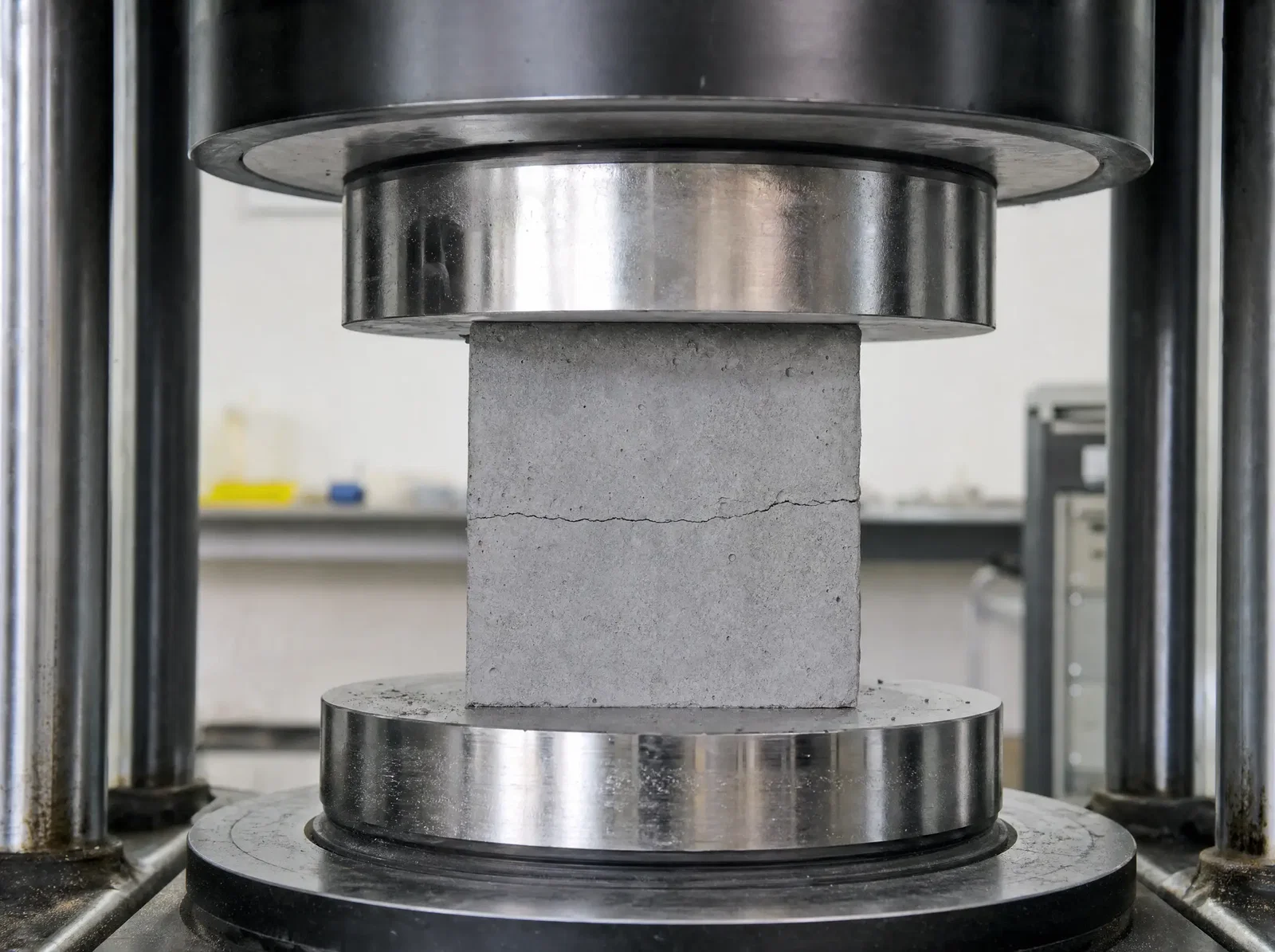
The figure in a grade designation — 22.5, 32.5, 42.5, 52.5 — is the guaranteed minimum compressive strength in megapascals at twenty-eight days. It is a floor. Works routinely produce above it, and a producer who did not would be gambling an entire consignment on a single test result.
The letter that follows is the other half of the specification, and it is often the half that decides a project's economics. N — written H in Russian designation — means a normal rate of early strength development. R, written B, means high early strength: the same class at twenty-eight days, reached faster over the first two. A precast yard buying 42.5R is not buying more strength. It is buying a shorter mould cycle.
The two are not interchangeable in a contract, and the choice between them is not a matter of preference. Specifying R where N would serve buys a finer grind that the works has to pay for and the structure will never use. Specifying N where the programme needs R gives back a casting cycle every day of the job. Both belong on the shortlist for exactly that reason.
One caution travels with every R grade. Faster strength means faster heat, and in a massive pour that heat has nowhere to go. The temperature differential between core and surface is what cracks a raft or a pier — which is why one project can correctly specify CEM I 42.5R for its precast elements and CEM III/A 42.5N for the foundation those elements stand on.

Two grades lead, and they do not compete for the same order
Demand in Türkiye distributes across ready-mix producers, construction companies and infrastructure projects in a pattern stable enough to plan a supply programme against. Two grades dominate, a third takes the cost-sensitive volume, and a fourth serves the works where durability rather than schedule is the binding constraint.
CEM I 42.5R and CEM I 42.5N sit at the top together, and they are not substitutes. The R goes where cycle time is the cost — ready-mix plants, precast beds, contractors carrying liquidated damages on the calendar. The N goes into general construction, housing and commercial work, where it is simply the most reliable and most easily traded cement in the world.
Below them, CEM II/A-L 42.5N absorbs the housing and infrastructure volume that is optimising on cost and on heat of hydration, and CEM III/A 42.5N takes ports, bridges, tunnels, marine structures and hydrotechnical work. That last grade never leads on tonnage and never leaves the list, because nothing else in the range survives sea water for a century.
| Grade | Demand | Principal applications |
|---|---|---|
| CEM I 42.5R | 5 of 5 | Ready-mix plants, precast concrete elements, projects requiring rapid strength gain. |
| CEM I 42.5N | 5 of 5 | General construction, residential and commercial projects. |
| CEM II/A-L 42.5N | 4 of 5 | Housing, infrastructure, cost optimisation, and applications requiring a lower heat of hydration. |
| CEM III/A 42.5N | 3 of 5 | Ports, bridges, tunnels, marine structures, hydrotechnical projects. |
| Grade | Demand | Principal markets |
|---|---|---|
| CEM I 42.5N | 5 of 5 | Türkiye, Iraq, Kazakhstan, Azerbaijan, the Gulf states. |
| CEM I 42.5R | 5 of 5 | Precast concrete production, infrastructure projects, ready-mix. |
| CEM II/A-L 42.5N | 5 of 5 | Europe, Central Asia, the Caucasus. |
| CEM II/B-L 32.5R | 4 of 5 | Residential construction, commercial real estate. |
| CEM III/A 42.5N | 4 of 5 | Ports, bridges, hydrotechnical structures, marine infrastructure. |
| CEM I 52.5R | 4 of 5 | High-strength structures, bridge construction, high-rise buildings. |
One consequence is worth stating plainly to a first-time importer. A consignment carrying two or three grades is normal on this corridor and attracts no meaningful handling penalty in bulk, because the cargo is segregated by silo at both ends rather than by hold. What does attract a penalty is a grade split fine enough to break the minimum lot — which is precisely why the four-grade shortlist exists.
Eighteen plants, a third of a market, and a map drawn by limestone
Cement is, by volume, one of the largest construction materials produced in Russia. Output is distributed across almost every federal district — enough to supply the domestic market and to make export possible to the CIS, the Caucasus, Central Asia and parts of the Middle East.
Production concentrates where two conditions coincide: limestone deposits and large consumer markets. That geography is fixed — a works cannot be moved closer to a port — and it is the first thing to verify when a specific plant is nominated against a shipment.
CEMROS is the largest player by a wide margin: eighteen cement plants and more than twenty production facilities, producing roughly 20.9 million tonnes a year — about a third of the Russian market. Gaz-Trans International works with this producer on a regular basis. The remaining share is divided among several large producers and independent works.
- Belgorod
- Bryansk
- Voronezh
- Lipetsk
- Mordovia
- Samara
- Chelyabinsk
- Sverdlovsk
- Leningrad
- Krasnoyarsk
- Karachay-Cherkessia
- Volgograd
- Novosibirsk
- Primorsky
| # | Company | Approximate position |
|---|---|---|
| 01 | CEMROS | Russia's largest cement producer |
| 02 | Sibirsky Cement (Sibcem) | Leader in Siberia |
| 03 | AKKERMANN Cement | Leading cement producer |
| 04 | Novoroscement | Strong position in southern Russia |
| 05 | Vostokcement | Leader in the Far East |
| 06 | Sebryakovcement | The largest independent works |
| 07 | Iskitimcement | Leading producer in Western Siberia |
| 08 | Gornozavodskcement | Major works in the Urals region |
| 09 | Katavsky Cement | Part of the CEMROS group |
| 10 | Mordovcement | One of CEMROS's largest plants |
- Kazakhstan
- Belarus
- Kyrgyzstan
- Uzbekistan
- Tajikistan
- Azerbaijan
- Armenia
- Mongolia
Sanctions have sharply reduced supply into the European Union, and producers have redirected toward the CIS, the Caucasus, Central Asia and the Middle East. Türkiye sits at the near edge of that redirection — closer to the loading ports than most alternative markets, with a construction sector large enough to absorb contracted volume rather than occasional spot parcels. That combination is what makes the discount in Section 15 economically rational for the seller as well as attractive to the buyer.
Four ways to move a powder, and what each one costs to handle
Cement is a bulk commodity that behaves badly. It is hygroscopic, it flows like a liquid when aerated and like rock when it is not, and it is worthless the moment it meets water. Every packaging decision is therefore a trade between handling cost and the risk of losing the cargo outright.
Bulk is the cheapest format and the reference basis for everything else. Big bags of one or one and a half tonnes are the most popular format among exporters, because they tolerate imperfect port infrastructure and can be broken down on site without a silo. Small sacks are a retail and small-parcel format, not appropriate for deliveries to Türkiye at the volumes discussed here. Containers are the fallback where a berth or a lot size will not support a bulk vessel.
The differences between them are not marginal. Big bags add the bag itself, the filling line, the pallet and the extra handling — and they add all of it to every single tonne. Fifty-kilogram sacks add more again, several times over. That is why sacking is a retail decision rather than a shipping one, and why a seaborne consignment of any size is quoted in bulk unless the receiving end genuinely cannot take it.
| Format | Unit sizes | Handling cost | Note |
|---|---|---|---|
| Bulk | 3,000 / 5,000 / 10,000 / 25,000 / 50,000 t | reference basis | The cheapest option. Requires silo capacity and pneumatic discharge at both ends of the voyage. |
| Big bag | 1,000 kg / 1,500 kg | moderate premium | The most popular format among exporters. Tolerant of limited port infrastructure; no silo required at site. |
| Sacks | 25 / 40 / 50 kg | highest premium | Retail and small export consignments. Not suitable for deliveries to Türkiye at the volumes under discussion. |
| Containers | 20ʹ ≈ 26–28 t | on application | Used where lot size or berth constraints rule out a bulk vessel, or where inland delivery follows directly. |
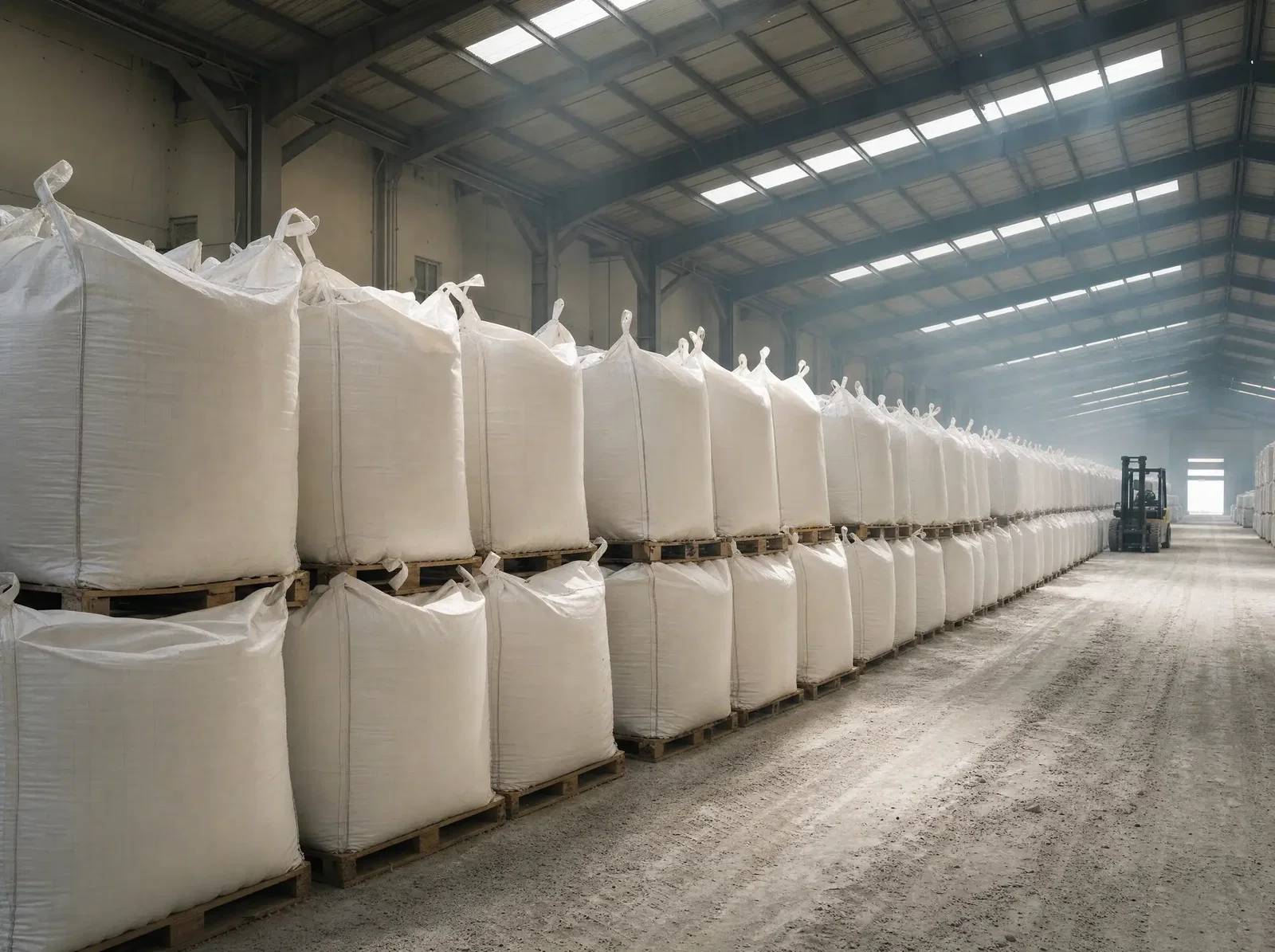
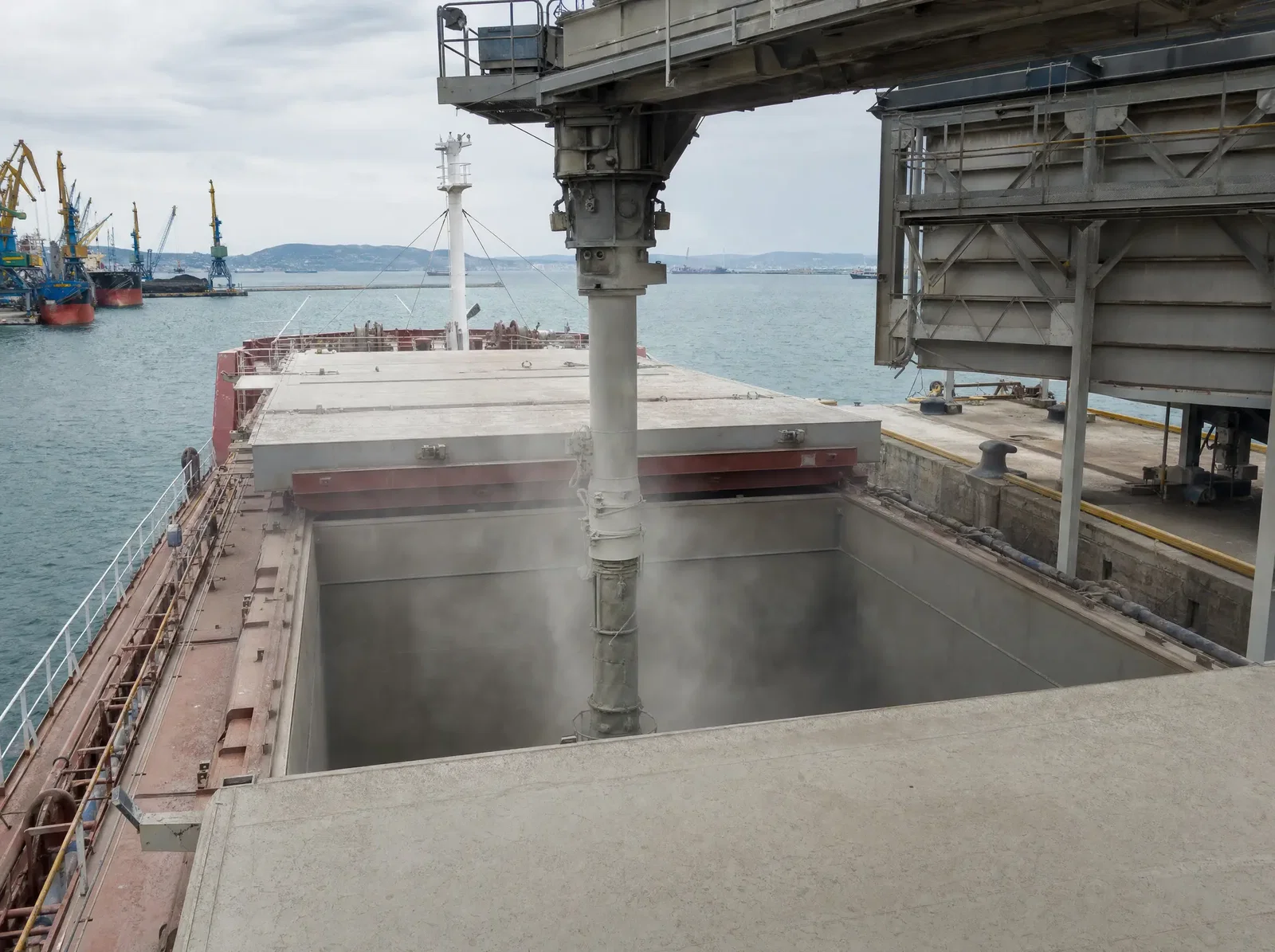
The lot sizes in the bulk row are not arbitrary. Below roughly three thousand tonnes the fixed costs of a voyage — port dues, agency, survey, demurrage exposure — begin to dominate the freight component, and the delivered cost rises although the cargo has not changed. Above twenty-five thousand tonnes the constraint moves from the ship to the discharge berth and the buyer's silo capacity. Five to thirty thousand tonnes is the band where the economics are most stable, and it is the band this dossier is written around.
A low-margin cargo, and the arithmetic that follows from it
Cement is a low-margin cargo. That single fact explains more about how this trade behaves than any specification in the preceding sections.
A typical delivered cost divides four ways. Production accounts for fifty-five to sixty-five per cent. Rail haulage to the port takes fifteen to thirty. Transshipment — the movement between rail wagon and vessel — takes five to ten. Sea freight takes ten to twenty. Only the first of those four adds value to the material. The remaining three are friction, and together they can consume close to half the landed price.
The consequence is direct. When exporting, the distance between the works and the loading port matters more than the distance between the works and the customer. A plant three hundred kilometres from Novorossiysk will land cement in Türkiye more cheaply than a larger, more modern plant fifteen hundred kilometres inland — and no amount of production efficiency closes that gap.
| Sea | Ports | Relevance to this corridor |
|---|---|---|
| Black Sea | Novorossiysk · Taman | The primary route to Türkiye and the shortest sea leg. Delivery to the Black Sea port is performed by the supplier. |
| Baltic Sea | Ust-Luga · St Petersburg | Serves northern Europe and long-haul destinations. A materially longer voyage to Turkish ports. |
| Caspian Sea | Astrakhan | Serves Iran, Turkmenistan and Kazakhstan. Relevant to onward regional trade rather than direct Turkish supply. |
For a Turkish buyer this reduces to one practical instruction: nominate the Black Sea. Novorossiysk and Taman give the shortest sea leg to the Turkish coast, they are the ports with which the supplier's delivery obligation is already aligned, and they are where the rail component of the cost structure sits at its lowest for the producing regions of southern Russia.
What a firm offer will contain
This dossier does not quote a price. Cement pricing moves with fuel, freight, the construction cycle and the size of the parcel in front of it, and a figure printed in a technical document is out of date before it is read. What can be set out in advance is the structure of a quotation — the variables that decide it, and the terms it will be written on.
Two bases exist in this trade and they must never be confused. FOB names the value at the loading port, with the buyer taking the cargo from the ship's rail onward. CFR names it delivered to a Turkish port, with the sea leg included. The two differ by the entire cost of moving a low-margin cargo across a sea. Any offer issued against this dossier will state both, so the freight component stays visible rather than buried inside a single number.
Everything else is a function of four variables. They are set out below in the order in which they actually move the figure.
- 01Lot sizeBelow roughly 3,000 t the fixed costs of a voyage begin to dominate. Between 5,000 and 30,000 t the economics are most stable. Above that the discharge berth and the buyer's silo capacity become the binding constraint.
- 02PackagingBulk is the reference. Big bags and sacks each add the packaging, the filling line and the extra handling to every tonne carried — not once, but per tonne.
- 03Grade and rate of gainThe R variant of a class carries a finer grind and the mill time that goes with it. CEM II and CEM III dilute clinker and move in the opposite direction.
- 04Port and timingBlack Sea loading is the short route to Türkiye; Baltic and Caspian loadings lengthen the sea leg materially. Shipment window and vessel availability move with the season.
| Item | Position |
|---|---|
| Basis | FOB Black Sea and CFR Türkiye, stated in parallel on the same sheet. |
| Product | Grade and strength class in modern designation — never an old mark alone. |
| Quantity | Lot size and shipment schedule, with the tolerance stated. |
| Packaging | Bulk unless otherwise agreed; any other format named explicitly. |
| Loading port | Novorossiysk or Taman. Delivery to the Black Sea port is performed by the supplier. |
| Validity | A stated period, beyond which the offer lapses rather than drifts. |
| Quality | Mill test certificate per production lot, against GOST 31108-2020 / EN 197-1. |
| Documents | Draft survey, hold cleanliness certificate, and an agreed sampling and retention protocol. |
One practical note for a first-time importer: ask for both bases on the same sheet. An offer quoted only on a delivered basis hides how much of the figure is cement and how much is sea, and it cannot be compared against a domestic Turkish quotation — which is normally given ex-works, and is therefore on a third basis again.
Beyond the five families — where cement stops being a commodity
The five CEM families cover construction. They do not cover everything Russian works produce. Alongside the standard range, plants make oil-well cement, sulfate-resisting cement, road cement, white cement, hydraulic cement, rapid-hardening cement, low-alkali cement and high-strength cement. Each exists because a specific failure mode had to be designed out.
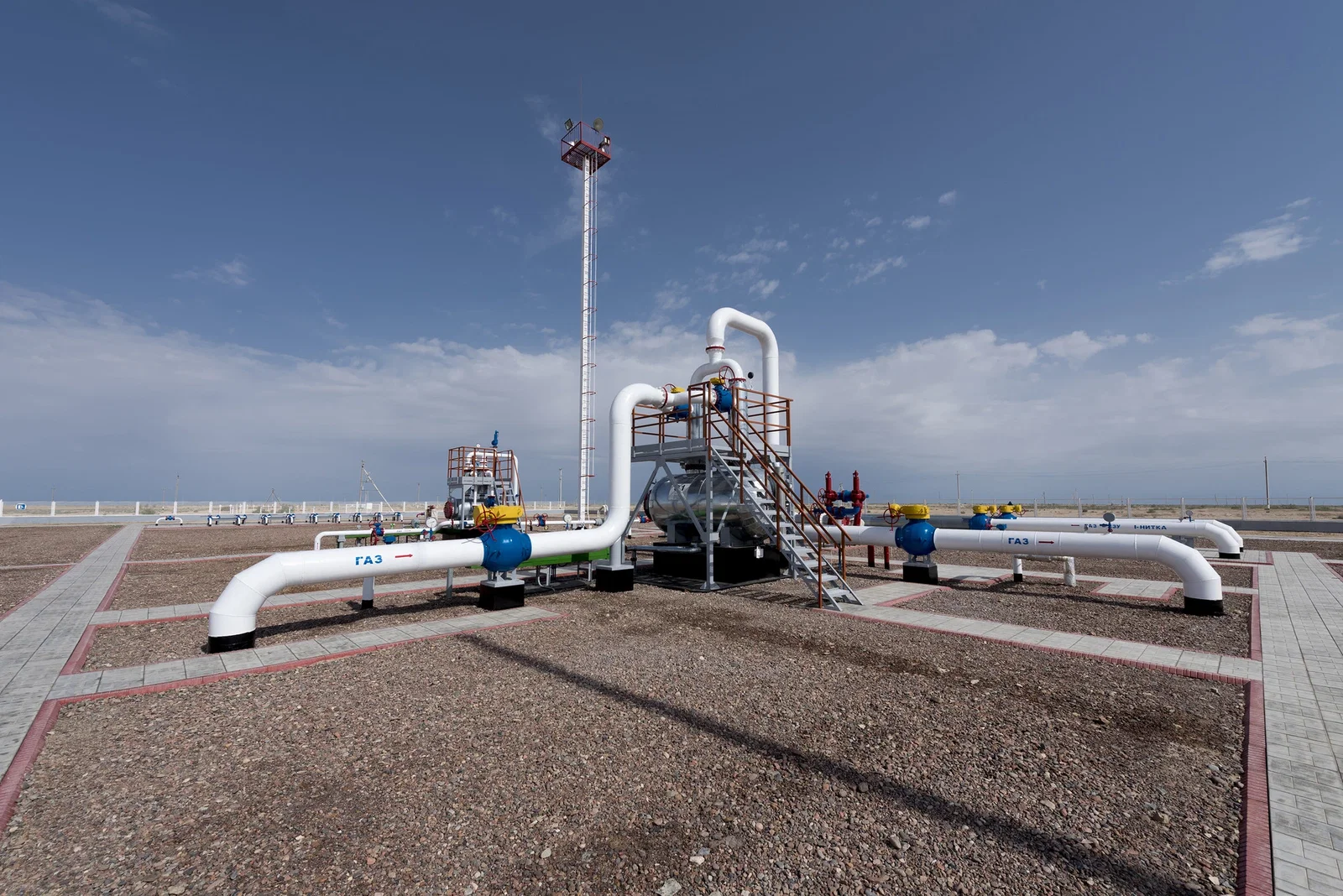
Oil-well cement is the clearest illustration, and it matters here because it is the point at which the cement trade meets the energy trade. A well is cemented by pumping slurry down the casing and back up the annulus, where it must set into a sheath that isolates the producing zone. If that sheath cracks, the well leaks — between formations, between fracture stages, or to surface.
The requirement is unusual: the set cement must be strong and elastic at the same time. Work on the Bazhenov formation, the largest shale play in the Russian Federation, established a stability window of six to nine gigapascals Young's modulus against thirty-two to thirty-six megapascals compressive strength for horizontal wells subjected to multi-stage fracturing. Conventional blends fell outside that window and were destroyed by frac pressure.
| Type | Designed against |
|---|---|
| Oil-well cement | Downhole temperature and pressure, and the mechanical load imposed by hydraulic fracturing. |
| Sulfate-resisting cement | Sulfate attack on the C₃A phase in aggressive ground and in sea water. |
| Road cement | Flexural fatigue and freeze–thaw cycling in pavement slabs. |
| White cement | Iron in the ferrite phase — the reason ordinary cement is grey. |
| Hydraulic cement | Setting and hardening under permanent water. |
| Rapid-hardening cement | The schedule itself, where cycle time rather than strength is the constraint. |
| Low-alkali cement | Alkali–silica reaction with reactive aggregates. |
| High-strength cement | Load, in structures where section size is constrained. |
- 6–9 GPa
- Young's modulus — stability window
- 32–36 MPa
- Compressive strength required
- 80–92%
- Good bond along the horizontal section
- 44% → 5%
- Screen-out during fracturing, after redesign
Susliakov, Shevchuk, Alekseev, Dryaba, Alyakin & Sekachev (2019). Well Cementing with Elastic Properties Cement Stone and Liner Rotation. SPE-198366-MS, SPE Annual Caspian Technical Conference, Baku.
For a Turkish buyer this section is a note on capability rather than an immediate offer — the four grades of the shortlist remain the subject of this dossier. But a producer that can hold an elastic modulus window four kilometres underground is a producer that can hold a twenty-eight-day figure in a silo, and the special range is worth knowing about before a project needs it.
The certificate, the sample, and the ninety days that follow
Cement arrives with a mill test certificate stating the grade, the strength class, the composition, the fineness and the results of the works' own testing on the production lot. It is a necessary document and it is not, on its own, sufficient — because the certificate describes the cement that left the silo, not the cement that arrived at the berth.
Two things happen in transit. Moisture is the first and the serious one: cement that has taken up water sets in the hold, in the bag or in the silo, and the loss is total rather than proportional. Contamination is the second — a hold that last carried fertiliser or coal, an auger that last moved a different grade — and it shows up as strength that fails to arrive rather than as anything visible on discharge.
Cement also ages in store. Even under cover it takes up atmospheric moisture and carbon dioxide, and strength falls with time. As a working rule the loss becomes measurable after about three months and material beyond six. A consignment bought against a project that then slips is a consignment quietly losing class in the silo.
| Stage | Check | Why it matters |
|---|---|---|
| At nomination | Works, grade and strength class named explicitly in the contract | “M500” and “CEM I 42.5N” are not the same instruction. The modern designation also fixes composition and rate of gain. |
| Before loading | Mill test certificate for the production lot | Ties the cargo to a tested batch rather than to a general specification. |
| At loading | Hold or container cleanliness certificate | Contamination stays invisible until the concrete fails to reach class weeks later. |
| At loading | Draft survey or weighbridge record | Establishes the quantity basis for the invoice and for any subsequent claim. |
| On arrival | Independent sampling and sealed retention samples | The only evidence available if a dispute over class arises after the cargo has been used. |
| On arrival | Moisture and lump inspection | Set lumps mean water reached the cargo. The claim window opens at discharge, not later. |
| In store | Silo rotation, first in first out | Strength falls with storage time regardless of packaging or grade. |
None of this is unusual for a bulk mineral cargo, and none of it is expensive relative to the value at risk. The most common and most avoidable loss on this trade is not a quality dispute over strength class. It is water, reaching a cargo that has already been paid for.
What actually goes wrong, and where it is cheapest to stop it
A cement import fails in a small number of predictable ways. None of them are exotic, and every one of them is cheaper to prevent at the contract stage than to argue about at the berth.
The register below is ordered by the cost of the failure rather than by its likelihood, because on this corridor the two run in opposite directions. The rarest failures are the ones that write off a cargo.
- 01
Moisture ingress
- Origin
- Ship's hold, bagging line, discharge in rain, condensation in a cold silo.
- Consequence
- Total loss of the affected tonnage. Set cement has no salvage value.
- Control
- Weather clause on discharge, sealed liners in bulk holds, moisture and lump inspection before acceptance.
- 02
Grade substitution
- Origin
- Loose contract wording — “M500” in place of a modern CEM designation.
- Consequence
- Concrete that misses class weeks after placement, when the structure already stands.
- Control
- Modern designation in the contract, mill certificate per production lot, sealed retention samples.
- 03
Contamination
- Origin
- Previous cargo in the hold; shared conveyors, augers and loading spouts.
- Consequence
- Strength loss and irregular set, invisible until laboratory testing.
- Control
- Cleanliness certificate at loading, independent survey, sampling of the first tonnes discharged.
- 04
Lot break
- Origin
- Ordering below the economic minimum, or splitting grades too finely across one voyage.
- Consequence
- Freight cost per tonne rises sharply and erodes the entire commercial advantage.
- Control
- Hold lots at 5,000 t or above; consolidate to the four-grade shortlist.
- 05
Demurrage
- Origin
- Discharge berth or silo capacity not matched to the vessel actually fixed.
- Consequence
- Daily charges accruing against the buyer while the cargo waits alongside.
- Control
- Confirm discharge rate and receiving silo capacity before the vessel is fixed.
- 06
Shelf-life erosion
- Origin
- Project slippage after the cargo has arrived and been stored.
- Consequence
- Certified class no longer achievable; retesting or downgrade required.
- Control
- First-in-first-out rotation; align the delivery schedule to the pour schedule.
- 07
Market movement
- Origin
- Fuel, freight and the construction cycle, between letter of intent and signature.
- Consequence
- A commercial position stated in one month does not hold in the next.
- Control
- Fix the basis and a stated validity period in the contract rather than relying on an indication.
Five of the seven controls above are contract clauses rather than operations. They cost nothing to insert and are almost impossible to add once a cargo is on the water.
The characteristic error of a first cement import is to negotiate hard on the figure per tonne and lightly on everything else. A hard-won concession on the commercial terms is measured in single digits per tonne. A wet hold is measured in the whole cargo.
The commercial framework, stated without softening
This dossier follows from a letter of intent dated 8 August 2026, issued by Gaz-Trans International in response to a request for a long-term, large-scale analysis of cement supply to Türkiye and, in a subsequent phase, to European Union countries.
The terms in that letter are stated plainly and deserve restating the same way. Delivery to the Black Sea port is performed by the supplier. The commercial context is equally plain: sanctions applied to the Russian Federation have redirected producers toward the remaining markets, and the seller has not concealed that this is the reason Türkiye is being approached with a long-term proposition rather than occasional cargoes.
For the buyer, that makes the position legible rather than generous. It is a function of a redirected market, not of goodwill, and it should be evaluated as such — including its durability, which is tied to conditions outside the control of either party.
| Term | Position |
|---|---|
| Products | CEM I 42.5N · CEM I 42.5R · CEM II/A-L 42.5N · CEM III/A 42.5N |
| Standard | GOST 31108-2020, aligned with EN 197-1. |
| Quotation basis | FOB Black Sea and CFR Türkiye, stated in parallel. Section 11 sets out how a firm offer is built. |
| Lot size | 5,000–30,000 MT bulk per shipment. |
| Delivery | To the Black Sea port, performed by the supplier. |
| Packaging | Bulk is the reference basis. Big bag and sack formats quoted on request. |
| Loading ports | Novorossiysk · Taman (Black Sea). |
| Quality | Mill test certificate issued against each production lot. |
| Onward phase | European Union destinations, subject to the regulatory position applicable at that time. |
- 01Confirm the requirementGrade and strength class, annual tonnage, and the window for the first shipment.
- 02Nominate works and portMatch the producing region to the Black Sea loading port — the rail leg is the largest variable in the delivered cost.
- 03Firm offerIssued on both bases with a stated validity period, lot size and packaging — the structure set out in Section 11.
- 04ContractModern designation, mill certificate obligation per lot, cleanliness and weather clauses, and an agreed sampling protocol.
- 05First shipmentDraft survey at load, independent sampling at discharge, retention samples sealed and held by both parties.
Issued by Gaz-Trans International, Foreign Sales Department · Signatory: S. N. Akimov, Authorised Representative · Reference: Doc No A109-499-0001, 8 August 2026.
One point of scope. The letter of intent addresses Türkiye first and the European Union as a later phase. Those are not the same commercial question, and this dossier deliberately answers only the first. Any onward movement into EU destinations must be assessed against the regulatory position applicable at that time, and nothing here should be read as an opinion on it.
What this document rests on
Every statement in this dossier comes from one of four places, and it is worth separating them, because they do not carry the same weight.
The commercial material — the priority grades, the lot sizes, the packaging formats, the producer ranking and the demand distribution — comes from the letter of intent and its accompanying market note, issued by Gaz-Trans International on 8 August 2026. It is the seller's own statement of position and should be read as such. This dossier deliberately quotes no prices.
The technical material — clinker chemistry, the process sequence, the classification tables and the strength framework — is standard cement science, checked against the reference literature listed below. The oil-well case data is drawn from a peer-reviewed conference paper and is cited where it is used.
| Source | Nature | What it supports |
|---|---|---|
| Letter of Intent, Doc No A109-499-0001. Gaz-Trans International, 8 August 2026. | Commercial | Commercial position, delivery terms and the four priority grades. |
| General terms for cement supply to Türkiye. Gaz-Trans International, 2026. | Commercial · technical | Classification tables, old-mark equivalences, producer ranking, loading ports, cost structure and packaging formats. |
| Chatterjee, A. K. (2018). Cement Production Technology: Principles and Practice. CRC Press / Taylor & Francis. | Reference literature | Raw materials, pyroprocessing and clinker cooling, clinker grinding, composition and properties of Portland cements. |
| Susliakov, Shevchuk, Alekseev, Dryaba, Alyakin & Sekachev (2019). SPE-198366-MS. SPE Annual Caspian Technical Conference, Baku. | Peer-reviewed paper | Oil-well cement case data: elastic modulus window, compressive strength requirement, bond quality, screen-out reduction. |
| GOST 31108-2020 · EN 197-1 | Standards | Family definitions, clinker content bands, strength classes, rate-of-gain indices and designation rules. |
A dossier of this kind is a briefing, not a contract. Where anything here differs from a signed offer, the offer governs.
End of dossier
The next step isa firm offer
This dossier answers the technical and commercial questions that come before an order. What it does not do is fix a price against a date. That requires a stated requirement — grade, tonnage and first shipment window — and it can be turned around against the framework set out in Section 15.
- CEM I 42.5NThe versatile grade
- 73
- CEM I 42.5RRapid strength gain
- 76
- CEM II/A-L 42.5NPrice against performance
- 70
- CEM III/A 42.5NPorts and hydraulic works
- 72